Preface: Why I Wrote This
There's a particular kind of night I suspect you know. You handled everything that needed handling that day. You were competent. And at 2 a.m. you're lying in the dark, wide awake, while your mind runs the same loops it ran last night.
I know that night well. I had a lot of them.
I grew up believing what most of us are taught to believe: that the way to be happy is to get a great education and then make a lot of money. So I chased both, hard. I got the gold medal in my engineering program. I launched and invested in businesses across several different industries.
And I won.
And I was still being tossed around by life.
Praise lifted me. Criticism dropped me. A good quarter and I felt like a king. A bad week and I couldn't sleep. I wanted more of everything. Getting it bought me a few days or weeks of quiet before the wanting came back exactly as strong. I had built a bigger, better, faster boat. I was still at the mercy of the same weather.
Then a wave hit that didn't care what I had built.
I won't go into it here. What matters is what it did to me. It broke the part of me that believed I could control how things turned out. It left me with nothing to do but surrender. Not as a spiritual technique. As the only thing left.
What happened after that surrender is the reason this book exists. How the teaching reached me is part of the same story. It's a strange enough story that I've put it at the end rather than the beginning. You can judge it for yourself when you get there.
What I found was not new. It's thousands of years old. Echoes of it sit inside every major tradition on Earth. The people who have kept it alive have guarded it carefully and understood it deeply. The problem is that almost none of it is written for someone like I was: busy, skeptical, with work and family stresses. I needed to understand quickly what to do and why, without sifting through spiritual language I couldn't follow or relate to.
So that's what this book is. A practical guide. A doorway into something much deeper.
It's a story about a wave that forgot it was the ocean. There are three parts, which explain where you came from, why life hurts and what to do about it. You can read the whole thing in an evening.
One more thing about the book itself. I could have written three hundred pages. Most books like this one are that long. Most of them are one part essence to three parts stories, restatements and filler. I'd rather hand you the essence. If you find something here worth having, read it three times instead of once. You'll get more from the third reading of a short book than from the first reading of a long one.
I'm going to ask you to believe nothing blindly. Some of what follows you can test against your own experience this week. I'll show you how as we go. Some of it is testimony from people who went further than I have. Some of it is faith. I'll mark the difference when we get there.
And if you only ever do one thing with this book, do the thing in the last chapter. Twenty minutes. Tomorrow morning.
The water under you is deeper than you think.
Shubniak Kumar
Chapter One: The Birth of a Wave
The Wave
One morning, far out at sea, a wave rose.
It came up out of the dark water and broke into the light. The first thing it knew was sunlight on its face. The second thing it knew was wind. The wind pushed it forward, faster than it expected. The wave found that it was moving.
It lifted higher. The water ran up its own slope and gathered at the top. There, at its crest, the wind tore a fine white spray off the edge of it and flung the drops into the air, where they caught the light and glittered.
The wave loved that. It felt enormous. It felt like the most alive thing in the world.
All around it, other waves were rising and falling. Some were taller. Some were smaller. Some were dark and heavy with sand. The wave looked at them the way you look at strangers on a train. It felt, without quite putting it into words, that it was better than most of them.
Underneath it, the water went down and down, past the reach of the light, into a stillness so complete that nothing there had moved in a very long time.
The wave had no idea that part was there.
It had no idea what it was made of, where it had come from, or where it was going. It only knew the sunlight and the wind and the glitter of its own spray. It assumed, the way anyone would, that this was all there was.
This is the story of a wave that forgot it was the ocean.
It is also your story. And to tell it properly, we have to go back. Before the wind. Before the first ripple. Before there was any water at all.
The Still Ocean
Long before any of that, there was an ocean.
It was not an ocean of water, because there was no water yet. There was no salt, no shore and no sky above it to turn the surface blue. There was no above and no below. There was no before or after, because nothing had happened yet that could come first or second.
What there was, was awareness. Quiet, whole and knowing.
It wasn't knowing something. There was nothing yet to know. It was simply knowing, the way a lamp in an empty room keeps shining even when there is nothing in the room for its light to fall on.
We picture it as an ocean because an ocean is easy to imagine and the rest of this story needs a picture we can hold. An ocean is vast. It is one substance all the way through. And far down, below the reach of every storm, it is perfectly still.
But this ocean had no floor. You could sink forever and never touch bottom. It had no shoreline where it ended and something else began. It wasn't sitting inside space the way our oceans do. Space would come later. When it came, it would appear inside the ocean.
Human traditions have given it many names: God, the Divine, Brahman, Allah, the Tao, the Absolute. Those names are not interchangeable. The traditions that use them differ in ways their followers take seriously. When Moses asked for a name at the burning bush, the answer recorded in the Book of Exodus was "I AM THAT I AM": a name that refuses to be a name. The oldest book of the Taoist tradition opens with a warning that any Tao you can put into words is not the true Tao. The saints of India simply called it the Nameless, because every name draws a fence around a thing. This had no fence. When we need a plain description, we'll call it Universal Consciousness: the one awareness in which everything else appears.
The ocean wasn't lonely. It wasn't bored or waiting for anything. It lacked nothing, the way a circle lacks no corners. And it was full of love. Not love for something, because there was nothing apart from it to love. Love was simply what it was made of, the way warmth is what the sun is made of.
And it was still.
A Hebrew psalm holds the whole secret of this book in a single line: "Be still, and know that I am God" (Psalm 46:10). Remember that stillness. The rest of these pages are about how it seemed to get lost and how it never actually went anywhere.
What this means
You might fairly ask how anyone could know what existed before anything existed. Nobody was there with a camera.
That's a good question and we won't dodge it. We won't start with belief at all. We'll start with the one thing in your life you cannot doubt.
You are aware.
Try doubting it. Go ahead. Notice that the doubting is itself happening in awareness. You can doubt that the world is real, that your memories are accurate, even that other people exist. But you cannot doubt that something is noticing. Every argument, every belief and every disbelief happens inside it.
Now try a small experiment. Close your eyes for half a minute and just listen. You'll hear sounds near and far: a car, a fan, your own breathing.
Your ears have limits, of course. A whisper on the far side of a stadium never reaches you. That's a limit of the ear. But look at the sounds that do reach you. Each one shows up in your awareness. Now search for the edge of the awareness itself, the border where it stops. You won't find one.
Here's a way to see the difference. With your eyes still closed, imagine a church bell ringing on the other side of the world. No ear could reach that far. Yet the imagined bell shows up in awareness instantly, no farther away than the fan in the room. In a dream you can hear thunder rolling over mountains you have never seen. The senses are like windows with frames. Awareness is the open space the windows look into.
Try another. What color is your awareness? How much does it weigh? Is it warm or cold? It's none of these. Colors, weights and temperatures show up in it. It holds them the way a movie screen holds a fire without getting burned.
One more. Think of yourself at seven years old. Most of the material your body was made of back then has since been replaced. Your size, your face, your opinions and your favorite foods have all changed. But the simple sense of being aware, of being the one who is here, feels exactly the way it did then. It hasn't aged a day.
So here is the one leap this story asks of you. What if the awareness you just examined, the one with no edge, no color and no age, isn't a small private thing sealed inside your skull? What if it is the same awareness everywhere? What if your body is simply one place where it's showing up?
Here's a picture that helps. Imagine an empty glass jar standing in a room. There's space inside the jar and space outside it. The glass makes it look like two spaces: the jar's space and the room's space. Now break the jar. Did the space that was inside go anywhere? Did it have to travel to rejoin the room? Of course not. It was never separate. Only the glass made it seem so.
Your body is the jar. The awareness looking out through your eyes is the space.
Seven hundred years ago a Christian mystic named Meister Eckhart said something very close to this. The eye through which he saw God, he said, was the very same eye through which God saw him. One awareness, looking both ways.
You don't have to believe this yet. Treat it as a map. A good map earns your trust the only way it can, by getting you somewhere. The rest of this book is the map and the last chapter is the journey.
One last thing. Almost everyone has had a moment, maybe only a few seconds long, of complete peace. Watching the sea at dusk. Holding a sleeping baby. Walking alone through fresh snow. In that moment nothing was missing. You didn't want anything. You weren't even thinking about yourself.
Notice that in those moments you didn't gain anything. Nothing was added to you. Something was taken away: the noise, the wanting, the busy feeling of "me." What was left underneath was quiet and it felt like love does.
That was a glimpse of the still ocean. It wasn't far away. It was underneath you the whole time.
The First Sound
Then the ocean stirred.
It wasn't a storm. It was more like a hum. Deep in the stillness the ocean began to vibrate, the way a held breath becomes a note when it is let go.
The vibration was a sound. Not a sound any ear could hear, because there were no ears. It was consciousness itself, humming. And inside that sound was everything that would ever exist: every star that would shine, every shape that would form, every creature that would breathe. None of it had appeared yet. All of it was already carried in the sound, the way a whole song is carried in a singer's first breath.
If you remember only one thing from this chapter, remember this sound. Everything that will ever exist is made by it, carried by it and held together by it. It didn't ring once long ago and then fall silent. It is sounding now, this moment, without a break. And like every current that flows out of a source, it can be followed back to where it came from.
The first region was pure consciousness itself. The sound poured out from its very centre. There was consciousness and its sound and nothing else. No shapes. No qualities. No separation, except the faintest film between the sound and the silence it came from, a film thinner than any word can describe. We'll call this region the Pure Sound.
The sound carried something within it, something like a wish. The sages of India put that wish into a few simple words: I am one. Let me be many.
And the sound began to flow outward to make it so.
The wave you met at the start of this book did not exist yet. Not even the idea of it. But the sound that would one day raise it was already on its way.
What this means
Here is the idea underneath this section: everything that exists is vibration.
That might sound mystical, but it's closer to ordinary than you'd think. Sound is vibration. A guitar string shakes the air and the air shakes your eardrum. Light is vibration too. It's a ripple traveling through electric and magnetic fields. The only difference between red light and blue light is how fast it ripples. Heat is atoms jiggling. Even the atoms in your hand, which feel so solid, are almost entirely empty space held in shape by energy.
It's remarkable how many traditions, which never met one another, put a sound or a word at the very beginning.
The Gospel of John opens with "In the beginning was the Word." Not a thing but a Word: divine expression, carrying meaning. In the Hebrew Bible God speaks the world into being. The Quran describes creation as a single command, Kun, meaning "Be." Hindu traditions describe Om as the original sound from which all things arise. The Sikh scriptures open with Ik Onkar, one creative vibration. The saints of India called this sound the Word or the Name. They didn't mean a word you speak with your mouth. They meant the living sound that speaks everything else into existence.
Modern science has its own origin story. It's worth a quick look as a comparison and not as proof. Physicists describe the early universe, about 13.8 billion years ago, as unimaginably hot and dense, with space itself expanding and cooling ever since. A faint glow of heat left over from that beginning still fills the entire sky. A small part of the static "snow" on old television sets, the fuzz between channels, was that ancient afterglow. The echo of the beginning was sitting in people's living rooms and almost nobody knew.
The spiritual story and the scientific story are not the same story. Science describes how matter and energy behave. It doesn't claim to explain awareness. But it's striking that both begin with the same shape: a stillness, a burst of energy and everything else unfolding from it.
Now the part that matters most for you.
If the sound flowed out, then it still connects. A river running down from a mountain spring is one continuous thing, spring to sea. Stand anywhere on its bank and walk upstream and eventually you arrive at the spring. You don't need to know the whole route in advance. You only need to keep going against the flow.
That's the whole secret of the last chapter, planted here at the start. The same sound that brought you out is the one that will carry you back. You don't have to build a road home. The road is already running through you.
But you're probably still wondering about the question we skipped. Why? Why would a perfect, complete ocean stir at all?
The traditions offer beautiful answers. You've already heard the one the sages of India give: the wish of the one to be many, for the sheer joy of it. Sufi teachers of Islam tell a story in which God is a hidden treasure who longed to be known and so made a world through which to be known.
But the Buddha told a story that puts the question in its proper place. A man is struck by a poisoned arrow. His friends rush to bring a doctor. But the man refuses to let anyone touch the arrow until he knows who shot it. What was the archer's name? What family did he come from? Was the bow made of wood or horn? What feathers were on the arrow? The man would be dead long before his questions were answered.
So what does a wise person do? Pull the arrow out first. Then, once you are healed, walk back along the path the arrow came from and see for yourself where it started.
That is the spirit of this book. You don't have to settle why the ocean stirred before you can take out the arrow. And when you make the walk back yourself, you won't need anyone's answer. You'll have your own.
I Am, Then Mind and Space
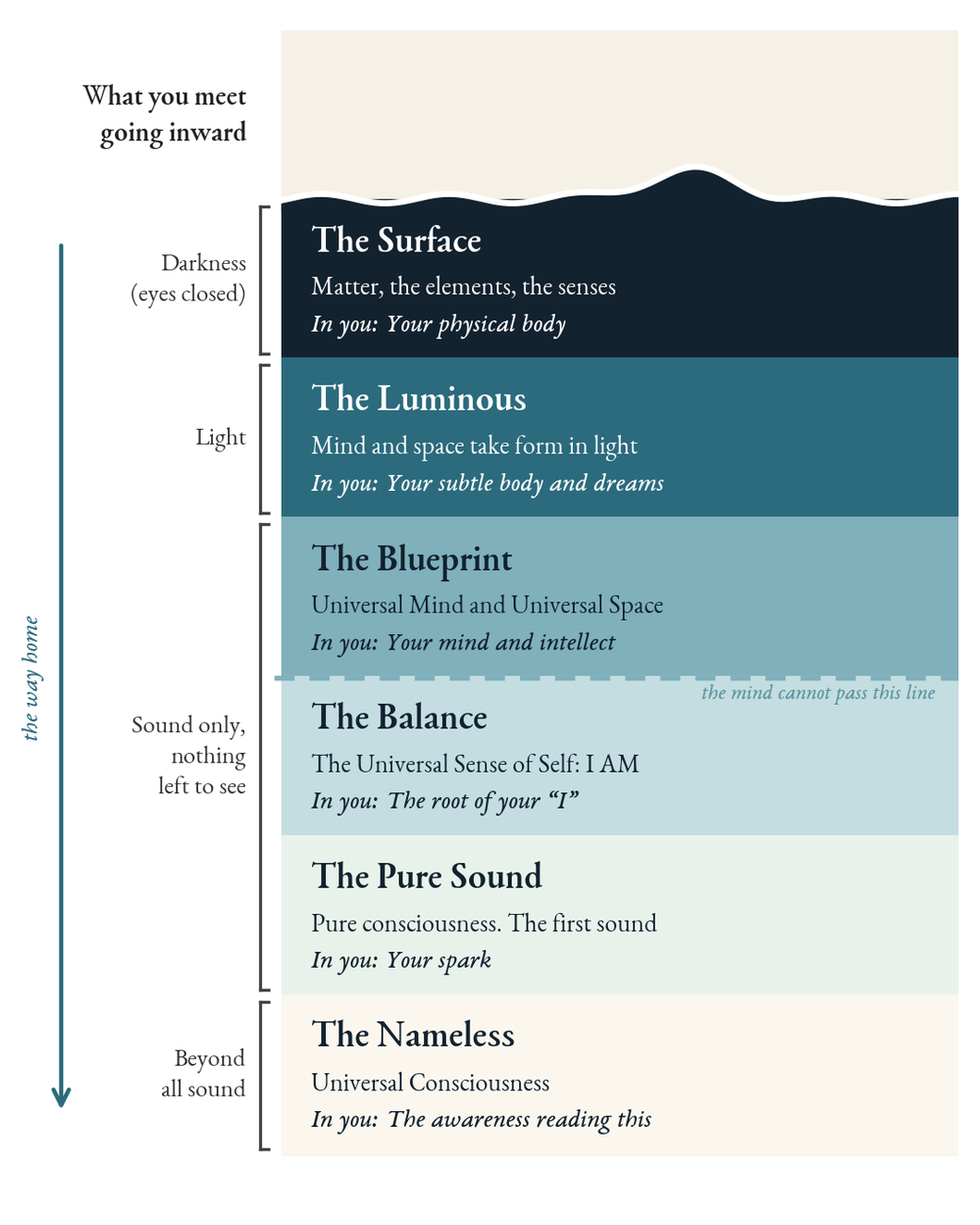
The six layers of the ocean, from the Surface down to the Nameless. The words on the left describe what someone meets when attention travels inward.
The picture above shows where this story is headed. Don't try to memorize it. Glance at it now and come back whenever you feel lost. We'll travel down through it one layer at a time in this chapter. We'll travel back up through it in the last one.
As the sound flowed outward from the Pure Sound, it slowed and thickened, the way a river slows when it spreads out across a plain.
And in that slowing, the wish let me be many found a center.
You've seen what happens when water slows and begins to circle. A whirlpool forms. A whirlpool is nothing but water. Yet it has something still water never had: a middle. For the first time there was a "here." And around that middle a vast, silent feeling arose: I AM.
This is the birth of the Universal Sense of Self. It is the whole of creation, for the first time, feeling itself as an "I." Not a person. Not anyone in particular. Just I AM.
The region where this happened was utterly quiet. Everything that would ever exist was present here. But nothing had begun. Three ways of moving were already there, ready to shape everything that would come: a clear and calm way, a restless and active way and a heavy and slow way. But here all three were held in perfect balance, like three dancers standing absolutely still in the instant before the music starts. Because they balanced each other exactly, nothing moved, so nothing happened. No thought. No shape. Only the great I AM and the sound flowing through it.
We'll call this region the Balance.
Something else appeared at the Balance for the first time: the first thin veil. The traditions call it maya. We'll look at it closely when our wave arrives. Here it was barely there at all. Every layer below would thicken it.
Then the balance tipped.
No one can say exactly what tipped it. But the three ways of moving began to move. The instant they moved, everything began to happen. The great I AM, which had rested in stillness, began to reach outward. It reached in two directions at once.
In one direction it became the Universal Mind: the formless side of creation, where sensing, feeling, wanting, remembering and imagining happen. You can't point to it. But it is where every experience takes place.
In the other direction it became Universal Space: the form side of creation, the room in which shapes can appear. Space has no feelings of its own, but without it there would be nowhere for anything to be.
Mind is how an "I" experiences. Space is where there is something to experience. One "I" reaching two ways.
Inside the Universal Mind one power stood out: the power to tell this from that. Light from dark. Here from there. Pleasant from painful. We'll call it intellect, the sharpest edge of mind: the knife that cuts the world into pieces so the pieces can be understood.
In this layer the patterns of everything were laid down: every galaxy, every tree, every person, every life. They existed here the way a house exists in an architect's head before a single line is drawn. There was still nothing to see. There was only sound, carrying the patterns. We'll call this layer the Blueprint.
Below the Blueprint, mind and space began to take shape together in light. For the first time in the whole story there was something to see. Patterns became forms, but forms with no weight. They were like the people and places in a dream: completely vivid, completely real to the one experiencing them and made of nothing solid at all. We'll call this layer the Luminous.
And below the Luminous, at last, Universal Space grew so dense that it became matter. Forms took on weight, edges and temperature. Stars formed, and planets, and oceans of real water and bodies. The Universal Mind, which had been free to feel anything at all, now began to feel the world through something new: senses.
This was the Surface. It is where you are sitting right now, reading this book.
Still no wave. But every layer it would one day be made of was now in place, stacked from the silence to the surface, waiting.
What this means
Picture a house being built. First someone has to say, "I am going to build a home." That's the sense of self. Then two things happen at once. There are the dreams and plans of what it will feel like to live there, which is mind. And there is the empty lot where it will stand, which is space. While the plans are being drawn, someone has to make hard choices: this wall goes here and not there. That's intellect. Only after all of that does the first brick arrive.
Creation, in this story, works the same way, only on the scale of everything. The Universal Mind stands where one person's plans were. Universal Space stands where the empty lot was.
Why should you care about any of this? Because the saints taught something remarkable: you are built from the same layers as the universe, in the same order. Every one of them has its copy inside you, stacked from the deepest to the shallowest. They even said that when you rise beyond a layer inside yourself, you have risen beyond that same layer of the universe.
Here is how the copies line up. Universal Consciousness is the awareness reading these words. The Pure Sound is still sounding in you; it is your spark, the part of you that is alive. The Universal Sense of Self at the Balance shows up in you as the plain feeling of being "I." The Universal Mind at the Blueprint shows up as your mind. Universal Space shows up as the room your body takes up. Your intellect is a small blade of that same discernment. The Luminous is your inner world of energy and dreams, which you visit every night. And the Surface is your body and its senses.
You aren't a small thing that happens to live in a big universe. You are the whole universe in miniature form, layer for layer. In the 1500s the Spanish mystic Teresa of Ávila described the soul as a castle with many rooms, one inside another, with God waiting in the innermost room. She was describing the same map.
Now notice two things in the picture that will matter a great deal later.
The first is the dotted line under the Blueprint. The mind is made of movement. A thought is something moving. A feeling is something moving. At the Balance nothing moves, so the mind simply cannot exist there. That means the mind can take you a long way inward, but it can never take you all the way home. Something in you that is not the mind will have to make the last part of the journey.
The second is the strangest thing about this ocean. In the oceans you know, the surface is bright and the depths are dark. In this ocean it's the other way around. The light comes from within.
Try it right now. Close your eyes. What do you see? Darkness. That darkness is the Surface seen from the inside. It's like standing on a sunny boat deck and staring down into deep water. The glare and churn at the top hide everything beneath. But the saints who made the journey report that if you hold your attention steady in that darkness, it gives way. First comes light. That's the Luminous. And deeper still, the light itself falls away and there is nothing left to see at all. There is only sound, growing purer as you go, until even the sound goes silent in the Nameless.
One Indian saint put it bluntly. Compared with the sun you'll find within, he said, the sun in the sky is dark.
A word about intellect, since people often say it's what makes humans special. Every living thing has some kind of mind. A dog wants, fears, remembers and loves. A crow can solve puzzles that stump small children. What's rare about human intellect isn't that it can think. It's that it can turn around and look at its own thinking. A person can ask, "Why do I keep wanting this?" A person can even ask, "Who, exactly, is the one asking?"
That second question is small, but it is a door. Intellect is the knife that cut the one ocean into pieces. It is also the only tool sharp enough to notice that the pieces were never really apart.
You now have the whole map. From the bottom up it runs: the Nameless, the Pure Sound, the Balance, the Blueprint, the Luminous and the Surface. You don't need to memorize it. The picture is here and there's a one-page summary at the end of this chapter.
For now, there is something better than memorizing it. You can watch it happen.
You Did It This Morning
Somewhere tonight a woman is sleeping so deeply that she is gone.
She isn't dreaming. There is no body, no bedroom, no name and no worry about tomorrow. If you could ask her in this moment who she is, there would be no one there to answer. Yet she hasn't died. Something is still present, resting in itself and lacking nothing.
Toward dawn, something stirs. A faint hum of awareness rises up out of the dark, too faint to be about anything. It is just a sense of being, before being anybody in particular.
Then comes a single word: I. Not "I, Maria, forty-three years old." Not yet. Only the bare feeling of a someone.
Then the mind switches on all at once, like the lights of an office tower flicking on floor by floor. Where am I? What day is it? Is it a workday? A worry left over from yesterday floats up. Then a plan. Then a craving for coffee.
Then the body arrives. A stiff neck. The warmth of a blanket. The weight of an arm lying across her chest.
And last of all comes the world. Gray light behind her eyelids. A bird outside. A car door slamming down the street. She opens her eyes. There is the ceiling and the room and the day. And there is Maria, fully assembled, swinging her legs out of bed as if she had been there all along.
The whole thing took about three seconds.
All over the world, every morning, billions of people surface exactly like this: up out of the still depths, into an "I," into a body, into a day. And far out on the ocean of our story, the same thing was about to happen. The sound was rising toward the surface. It was carrying a wave.
What this means
Look at what just happened, step by step. Set it beside the story of creation. Glance back at the picture if it helps.
Deep dreamless sleep, where there was no "I" and no world, yet not nothing: that was the still ocean, the Nameless. The first faint hum of awareness was the Pure Sound. The bare sense of "I" before any name was the Balance, the silent I AM. The mind flooding in with where, when, worry and want was the Blueprint, the Universal Mind lighting up. The sensations of the body were the Luminous thickening into weight. And the room, the light and the bird were the Surface.
You replay the creation of the universe every morning in about three seconds, before you've even opened your eyes.
This is why this chapter doesn't ask you to believe anything. You've done this every day of your life. You've simply never slowed it down enough to watch.
So try it tomorrow. The moment you realize you're waking up, before you move and before you reach for your phone, stay perfectly still. Notice the order in which things arrive. Notice that "I" shows up before your name and your problems do. Notice that the world arrives last. You may only catch a flicker of this at first. That's fine. Even a flicker counts.
The same thing happens in reverse every night. As you fall asleep, the room fades first. Then the body grows vague. Then thoughts loosen into strange, drifting pictures. Then the "I" itself dissolves. Surface, Luminous, Blueprint, Balance, depths. Every night you descend. Every morning you rise. The entire journey of this book, out and back again, you already make twice a day.
Now consider something odd about deep sleep. When you wake from a truly deep night, you say, "I slept wonderfully." But in dreamless sleep there was no experience at all, no pictures and no thoughts. So how do you know it was wonderful? Something must have been there to register the peace of it. Awareness never switched off. Only the "I" and its world switched off. What remained was restful, whole and good.
Every human being, every single night, sinks back into that stillness. The saint and the thief, the queen and the prisoner all return to the ocean for a few hours and come back refreshed. The difference is that they go there unconscious. That difference is the whole point of this book. They sink into the depths asleep. When they come back up, they don't remember where they've been.
The practice in the last chapter is, in one sense, learning to go where deep sleep goes while staying awake.
The Foam
The sound kept flowing up from the depths. Out of it, countless streams began to rise, the way bubbles rise in endless strings from a vent in the ocean floor.
Each stream carried a single spark of the Pure Sound. And each one rose through every layer on its way up.
As it passed through the Balance, it took on its own small "I," a tiny copy of the great I AM. As it passed through the Blueprint, it took on its own small mind with a small intellect at its edge and a small patch of space to call its own. It took on its own particular mixture of the three ways of moving. And at every layer it took on a little more of the veil.
As it passed through the Luminous, it took on a body of light. As it reached the Surface, it took on a body of matter with senses to feel the world. Nothing was lost on the way up. The spark was still at its root. It had simply put on coat after coat after coat.
Then each stream broke through the Surface into open air and became a wave.
One of those waves is the wave of our story.
It rose out of the sea into sunlight and wind. It lifted, gathered height and leaned forward. At its very crest, where water met air, something happened that happens at the top of every wave in every ocean. The water began to churn with air. It turned white.
Foam.
The foam was bright and busy and beautiful. It sparkled. It hissed. It looked nothing at all like the quiet water underneath.
The wave could feel its foam. It could feel the wind pushing it and the sun warming it and the other waves jostling on either side. It could feel itself as that bright, noisy crest.
What it could not feel was the long column running down beneath it through the Luminous and the Blueprint and the Balance, all the way down to the Pure Sound and the stillness. That column hadn't disappeared. It was all still there. But the crest was loud and the depths were quiet. And the foam was so bright that when the wave tried to look down into itself, it saw only black. The wave, as anyone would, paid attention to the loudest, brightest thing.
So it forgot.
It never decided to forget. Nobody ever does. It just stopped noticing, one busy moment at a time.
The wave looked around. Every wave on the surface looked a little different. Some rose from clear water and seemed to glow from the inside. Some were whipped high and jagged by the wind, never settling. Some were thick and dark with churned-up sand, heavy and slow to move.
The wave didn't wonder why. It was far too busy being a wave.
What this means
First, a surprising fact about waves, one worth sharing at dinner.
When a wave crosses the open ocean, the water doesn't travel with it. If you've ever watched a seagull floating on the sea as waves roll past, you've seen this. The gull bobs up, forward, down and back in a small circle. It ends up almost exactly where it started. The water beneath the gull does the same thing. What travels across the ocean isn't water at all. It's energy passing through the water, taking the shape of a wave for a while.
So what is a wave, really? It's a shape the ocean makes for a time. It has a real form, a real height and a real direction. It can smash a pier to pieces. But you can't lift a wave out of the ocean and keep it in a bucket. There is no wave-stuff separate from water-stuff.
You are like that. Your body, your personality and your life story are a real shape with real force. But the substance of you, the awareness you examined at the start of this chapter, never left the ocean for a moment.
Now, the foam.
Foam is mostly air bubbles held in water. All those tiny surfaces scatter light in every direction, so the foam looks white and solid. You'd never guess a whitecap is the same substance as the deep water beyond it.
This is the veil that first appeared at the Balance. It's usually translated as "illusion," but that translation causes trouble, because it makes people think the world is fake. It isn't. A better translation is the magic that makes a thing look like something it isn't. The foam is real. It simply hides what it's made of. The wave isn't wrong to think it has a crest. It's only wrong to think it is nothing but a crest.
The veil is thinnest in the depths and thickest at the Surface, the way foam is whitest where the churning is wildest. So what is the "air" that churns into you and turns you white? It is the mind and senses rubbing against the world. Every craving, every irritation, every "that's mine" whips a little more air into the water. The more churning there is, the thicker the foam becomes and the harder it is to see through to what's underneath. That is why, when you close your eyes, you see darkness instead of light.
Now, why did the waves look different from each other?
Remember the three ways of moving that sat perfectly balanced at the Balance and began to move at the Blueprint. The traditions of India describe them as three basic qualities mixed into everything, including you. The easiest way to understand them is as three kinds of water.
The first is clear water, calm and transparent. This is the quality of clarity: peaceful, kind, awake and content. When it's strong in you, you can see a long way down.
The second is wind-whipped water, choppy and restless. This is the quality of drive: ambitious, energetic, agitated and always needing to do the next thing. It gets things done. It rarely rests.
The third is muddy water, thick and slow. This is the quality of heaviness: dull, stuck, sleepy and unable to be bothered. It resists movement of any kind.
You can check this against your own life in a single day. Early morning after a good night's sleep, sitting quietly with a cup of tea, the water is clear. At two in the afternoon with a deadline and six messages waiting, the water is whipped. After an enormous dinner, sprawled on the couch scrolling through nothing, the water is muddy.
Every person has all three. What makes people different is the mixture. And the mixture shifts constantly. None of the three makes someone a good or bad person. They are more like weather. But notice this: only clear water can be seen through. You cannot look down into a churning sea or a muddy one. That's why, later in this book, we'll talk about the simple things that help the water settle.
This also explains something that puzzles people. If we all come from the same ocean, why are we so different? Because every wave is the same water mixed with different amounts of wind and sand and wrapped in a different thickness of foam.
Ice, Water, Vapor
On a wooden dock at the edge of a harbor, someone left a block of ice.
At first it sat there hard and square, cold enough to sting a hand. It had sharp corners and a definite place. You could point to it. You could pick it up.
Then the sun came out.
The corners softened. The block slumped. Water began to run from it in thin streams. Then the ice was gone. In its place a puddle spread across the boards, taking the shape of every crack and groove. You could no longer pick it up. You could only watch it flow.
The sun kept shining. By afternoon the puddle had shrunk to a damp stain. Then even the stain was gone. The dock was dry.
The water hadn't vanished. It had risen into the air as vapor, invisible, drifting out over the whole harbor, spread too thin to see or touch. It was everywhere now and nowhere you could point to.
A few days later, clouds gathered over the sea and it rained. Some of that water, which had once been a block of ice on a dock, fell straight back into the ocean it had come from.
What this means
Here's the physics and it's simple. When ice melts and then evaporates, the water molecules don't change. The same molecules are in the ice, the puddle and the vapor. Nothing new is added except energy. The only difference is how tightly the molecules hold on to each other.
In ice, they're locked in place, so ice has a fixed shape and sits in one spot. In liquid water, they slide past each other, so water has no shape of its own and takes the shape of whatever holds it. In vapor, they fly apart. Vapor spreads out to fill any room it's in and you can't see it at all.
Notice the pattern. The subtler the form, the less visible it is, the less it's stuck in one place and the farther it spreads.
That is exactly how the layers of you are arranged.
Your physical body is the ice. It's solid. It has edges. It's in one place at a time. You can weigh it, photograph it and bump it into a table. It's the densest, most visible and most limited part of you. It belongs to the Surface.
Your subtle body is the water. This is your energy, your feelings and the body you have in dreams. It flows. It takes the shape of whatever it's in. A room full of angry people leaves you feeling angry. A room full of calm people leaves you calm. It belongs to the Luminous. You can notice it tonight. In a dream you see without using your eyes, since your eyes are closed. You hear without using your ears. You run, fly and talk without moving a muscle. The traditions read this as a subtler layer of you, wearing a body of its own.
Your causal body is the vapor. This is the deep pattern of you: your mind's root tendencies, your mixture of the three qualities and the blueprint that keeps shaping the kind of life you find yourself living. You can't see it or touch it. It doesn't even show up as pictures the way dreams do. It's part of what is still there in deep dreamless sleep. It's why you wake up as recognizably you instead of somebody else. It belongs to the Blueprint.
Deeper than the vapor, the traditions describe one more covering, subtler than anything a harbor can show us. It belongs to the Balance, where your small "I" rests in perfect stillness. Here our analogy runs out. It's honest to say so. Every map eventually says "here the known roads end." The traveler goes on anyway.
And what melted the ice and lifted the vapor in the first place? The sun's energy. Notice that the energy isn't a form of water at all. It's what makes the water change. In you, that energy is your spark from the Pure Sound, which moves through every layer while being none of them.
Now, one more piece of the Surface.
When Universal Space finally condensed into matter, the old traditions said it happened in five stages, each one denser than the last. These aren't the elements of a chemistry class. Think of them as the five ways the physical world can show up to a living being. Each one, the traditions said, brought with it a new sense.
First came space, whose quality is sound: the openness in which anything can echo. Then came air, which added touch. You can't see wind, but you can hear it and feel it. Then came fire, which added sight. Fire makes light and light is what eyes are for. Then came water, which added taste. You taste nothing that's completely dry. Finally came earth, the densest of all, which added smell. Solid things give off scent.
Each stage kept the senses of the one before it and added one more. That's why earth, the heaviest element, can be heard, touched, seen, tasted and smelled, while space can only be heard.
Alongside these five senses, the body was given five ways to act on the world. It can speak, handle, move, reproduce and eliminate. We won't go further into those here.
But notice one thing about the order of the senses, because it will matter later. Smell is tied to the densest layer. Sound is tied to the subtlest. Sound is the first sense to appear on the way out and the last to fade on the way in. Anyone who has meditated, or even simply fallen asleep, has noticed that sounds are often the last thing to slip away.
The poet-saint Kabir, who was claimed by Hindus and Muslims alike, said the Word is ringing inside every body. This is the sound you were asked to remember at the start of this chapter. Now you know why it matters: it is the last thing to fade on the way in. It is the first thing that calls you home.
The Car and Its Sleeping Owner
There was once a man who owned a beautiful car.
He had a long journey ahead of him, all the way home. He was tired. So he hired a driver, climbed into the back seat, said "Take me home" and fell asleep.
The driver was capable and meant well. But the car he'd been handed was a strange one. Its steering wheel had a will of its own. Whenever the headlights caught something bright, like a flashing sign or a glowing diner or a crowd laughing on a corner, the wheel pulled toward it. The driver could pull back. Sometimes he did. But he was tired too and often it was easier to let the wheel have its way.
The car had one more peculiar feature. A small camera on the dashboard recorded every mile and sent it to a storage vault somewhere. The vault never filled up, so nothing was ever deleted. Every time the car passed something the vault had recorded before, the wheel pulled toward it a little harder than last time.
So the car wandered. It took detours. It circled the same neighborhoods again and again, pulled back to the same glowing signs. Hours became days and days became years. The car picked up scratches and dents. It ran low on fuel and was refilled. It was waxed and admired. Eventually it began to rust.
In the back seat the owner slept on. He had been asleep so long that he'd begun to dream he was the car. When a door got dented, he dreamed that he'd been wounded. When the paint was polished, he dreamed that he was beautiful. When the fuel ran low, he dreamed that he was dying.
He had forgotten he owned the car. He had forgotten he'd asked to be taken home. He had forgotten there was a home at all.
What this means
Here is the map of the car.
The owner is you: your spark of the Pure Sound, the part that is aware of everything else.
The car is your body. It's a remarkable vehicle and deserves good care. But it's something you have, not something you are.
The driver is your intellect, the part of you that can judge, decide and correct course. It's capable. But it's often tired and it tends to follow the path of least resistance.
The steering wheel is your mind, your small copy of the Universal Mind. It turns the whole car. And it has a will of its own.
The headlights and windows are your senses. They show the mind what's out there. Whatever they light up tugs at the wheel.
The camera and the vault are your memory. Think of your phone. If it uploads every photo to cloud storage that never runs out of space, it never asks you to delete anything. So you never do. The pile grows forever. Your mind works the same way. It stores traces of every experience, every pleasure, every hurt and every craving in a vault with no limit. Because the vault never fills, nothing ever forces a cleanup. And each stored impression is a small pull on the wheel.
The owner dreaming he is the car is your sense of self gone astray. Your "I" is a small copy of the great I AM. It's useful; someone has to be at the center of experience. But once it's wrapped in the veil, it attaches itself to whatever is nearest. My body. My car. My opinion. My reputation. Before long a scratch on the paint feels like a wound in the soul.
Since the next chapter is all about the mind, let's spend a little time on it now. Five things about the mind will explain nearly everything that follows.
First, your attention can hold only one thing at a time. It feels as if you're thinking many thoughts at once. Really your attention is switching between them very fast, the way a movie is really twenty-four still pictures a second that your eyes blend into motion. Try this: think "blue elephant" and "my phone bill" at exactly the same instant. You'll find yourself flicking between them. This one fact turns out to be enormously important. Whatever sits in that single seat is, for that moment, running your life. Fill the seat with something peaceful and there's no room left for anything else. We'll use that in the last chapter.
Second, the mind faces outward. Your eyes can see everything except themselves. The mind is the same. It naturally pours out through the senses toward the world, following the same outward flow as the sound that came from the depths. That's why turning attention inward feels awkward and hard at first. It's like swimming upstream. It's not that you're bad at it. You're going against the natural flow and every swimmer finds that hard in the beginning.
Third, the mind runs in grooves. Picture rain falling on a bare hillside. The first rain runs down in random trickles. But each trickle cuts the dirt a little, so the next rain follows the same path and cuts it deeper. After enough storms, every drop runs down the same channels. Every time you repeat a thought, a reaction or a habit, the groove deepens. The next time, the mind slides into it more easily. This is why habits are so hard to break and also why good ones, once built, run almost by themselves.
Fourth, the mind is always seeking pleasure and it is never satisfied. You get the thing you wanted. Within days, sometimes hours, the mind is wanting something else. Why? The traditions give a beautiful answer. What the mind is really hungry for is the peace of the still ocean, the wholeness you glimpsed in those rare, perfect moments. But it's searching for that peace out in the world, where it can only find small, fading imitations. It's like the old story of a man searching for his lost keys under a streetlight. Someone asks, "Did you drop them here?" He says, "No, I dropped them in my house. But the light's better out here." The mind searches outside because that's where its headlights point. The keys are inside.
Fifth and most important: the mind is not you. Try this right now. Sit still and watch your thoughts come and go for a minute, the way you'd watch cars passing on a street. A thought appears, lingers and leaves. Another arrives. Here's the question: if you can watch your thoughts, who is doing the watching? Notice the difference between the thought and the awareness the thought is appearing in. They are not the same thing. And remember the dotted line in the picture. The mind is made of movement, so it can't follow you into stillness. The owner can go places the steering wheel never can.
That's the owner in the back seat, stirring.
The mind isn't an enemy. It's a brilliant servant and a terrible master. A car without steering would be useless. The only problem is that the owner fell asleep and the steering has been running the trip.
And the driver, your intellect, has a rearview mirror. Every so often, glancing up at a red light, the driver catches a glimpse of someone asleep in the back seat and wonders, Whose car is this, anyway? Where were we going?
That question is the beginning of everything in this book.
The Finest Drop
We began this chapter with a wave rising into the sunlight. Let's go back to it, now that you know what it's made of.
Sunlight poured across its crest and turned the foam to sparks. It was taller than the waves beside it, or at least it felt that way. It was moving fast. It was sure it was going somewhere important.
Then the wind gusted across its peak and flung a single drop of spray into the air.
For one glittering instant the drop flew free. It caught the sun. It was round and bright and perfect. It seemed to belong to nothing at all. And in that instant the wave's whole sense of itself leapt up into the drop.
The drop looked down at the waves below. That one was too small. That one was too slow. That one was muddy. That one was so busy crashing into everything that it was hardly worth noticing.
Then it felt the sunlight shining right through itself. It felt a warm, full swelling of pride.
I am a drop of water, it thought. And not just any drop. I am the finest drop in all the sea.
It was wrong about almost everything in that sentence.
It was not really a drop. It was a moment of a wave, flung up by the wind, already on its way back down. The whole wave was beneath it. The whole ocean was beneath the wave.
It was not the finest. It was the same water as every other wave, the muddy one and the small one and the crashing one, mixed with a little more sunlight and a little more air.
And at its root it was not even a wave. It was the ocean, making a wave-shaped movement for a while.
None of that mattered to the drop just then. The sun was warm. The air was bright. The whole shining surface of the world was spread out below it.
Far beneath the foam and the darkness under the foam, beneath the Luminous and the Blueprint and the Balance, the sound still flowed up through the wave from the Pure Sound. It hummed as it always had, all the way down to the stillness. It asked for nothing. It was in no hurry. It had carried the wave up. It was patient enough to wait until the wave wanted to come back.
Someday the wave would begin to notice that it was more than a drop. Later still, it would discover that it was more than a wave.
But not yet. The drop did not hear the sound. The wind was too loud.
And the wind was only beginning to rise.
The Map So Far
For readers who like to see the whole picture in one place, here are the six layers described in this chapter, from the deepest to the surface. The first column gives the name used in this book, with the name used by Maharshi Mehi Paramhans and the tradition of the saints in parentheses. You don't need to memorize any of it. In the last chapter we'll travel these layers in the other direction.
| Layer | What arises there | Its copy in you | What you meet going inward |
|---|---|---|---|
| The Nameless (Anami, the Soundless State) | Universal Consciousness. Pure awareness and love. | The awareness reading these words | Beyond all sound |
| The Pure Sound (Kaivalya, the conscious sphere) | The sphere of pure consciousness. From its centre the first sound flows: "I am one, let me be many." | Your spark | The purest sound |
| The Balance (Mahākāran, supra-causal) | The Universal Sense of Self. The three qualities held perfectly still. The veil begins. | The root of your "I" | Sound only. The mind cannot enter. |
| The Blueprint (Kāran, causal) | Universal Mind (formless) and Universal Space (form). Intellect. The three qualities start moving. The patterns of everything. | Your mind and intellect. Your causal body (the vapor). | Sound only, nothing to see |
| The Luminous (Sūkshma, subtle) | Mind and space take weightless form in light. | Your subtle body and dreams (the water) | Light, then sounds |
| The Surface (Sthūla, gross) | Matter, the five elements and the five senses. | Your physical body (the ice) | Darkness behind closed eyes |
Many Waves, One Ocean
"To what is One, sages give many a title; they call it Agni, Yama, Matarisvan."
Rig Veda 1.164.46, translated by Ralph T. H. Griffith (Hindu)
"Whither shall I go from thy spirit? or whither shall I flee from thy presence? If I ascend up into heaven, thou art there."
Psalm 139:7–8 (Jewish)
"Unto Allah belong the East and the West, and whithersoever ye turn, there is Allah's Countenance."
Quran 2:115 (Islam)
"Allah is the Light of the heavens and the earth."
Quran 24:35 (Islam)
"For in him we live, and move, and have our being."
Acts 17:28 (Christian)
"God is love; and he that dwelleth in love dwelleth in God, and God in him."
1 John 4:16 (Christian)
"The Tao produced One; One produced Two; Two produced Three; Three produced All things."
Tao Te Ching 42, translated by James Legge (Taoist)
"This mind, mendicants, is radiant. But it's corrupted by passing corruptions."
Anguttara Nikaya 1.49, translated by Bhikkhu Sujato (Buddhist)
"The Divine Light is within everyone; You are that Light."
adapted from Guru Nanak, Guru Granth Sahib 663 (Sikh)
"As the flowing rivers disappear in the sea, losing their name and their form, thus a wise man, freed from name and form, goes to the divine Person, who is greater than the great."
Mundaka Upanishad 3.2.8, translated by Max Müller (Hindu)
Chapter Two: The Life of a Wave
Tossed
The wind found the wave before the wave had even finished rising.
It came from the left first, a quick shove that tipped the wave sideways. Then from behind, pushing it forward faster than it wanted to go. Then a gust from nowhere lifted its crest high into the sunlight. The wave loved that. It wanted more of that. But before it could enjoy the height, a crosscurrent dragged it down into a trough between two larger waves, where it couldn't see anything at all.
Up. Down. Left. Forward. Sideways again.
The wave's sense of itself still lived where it had leapt on that first morning: up in the flying spray at the very tip of its crest. That was the part the wind could fling the hardest. So every gust felt enormous.
The wave didn't choose any of it. It just reacted. When the wind lifted it, it felt proud. When the wind dropped it, it felt small. When another wave bumped it, it felt angry and shoved back. When a patch of warm sunlight fell across it, it tried to stay there. But the water kept moving and the sunlight slid away.
By midday the wave was exhausted. By afternoon it couldn't remember what the morning had been like. It only knew that the wind never stopped and that it had to keep reacting to whatever came next.
Far beneath it, the water was perfectly still. The wave didn't think about that. The wave didn't think about anything except the wind.
What this means
Let's see if any of this sounds familiar.
Your alarm goes off. Before your feet touch the floor, you've reached for your phone. There are fourteen notifications. One is from work and your stomach tightens. One is a photo of a friend on vacation and you feel a small twist of envy. One is a news headline that makes you angry before you've even read the article.
You haven't brushed your teeth yet and you've already been pushed three directions.
You rush through breakfast while thinking about a meeting. In the meeting, you think about an argument you had last night. During lunch, you scroll. In the afternoon someone praises your work and you feel ten feet tall. An hour later someone criticizes it and you feel like a fraud. You spend the drive home replaying both conversations. At dinner you're physically at the table but mentally somewhere else. You have a glass of wine, then another, to take the edge off. You watch something you won't remember. You go to bed tired but your mind won't stop. At 2 a.m. you're awake, rehearsing tomorrow's problems in the dark.
Then the alarm goes off again.
That's a day on the surface. Not a bad day. An ordinary one.
Notice something about it. Almost nothing in that day was chosen. It was all reaction. A notification pushed. A comment lifted. A criticism dropped. A craving pulled. You were busy the entire time, but you weren't really steering. You were being tossed.
Most people live their whole lives like this, in the top few feet of the ocean. Not because they're weak or foolish. Because the surface is where the wind is. And nobody ever told them there was anywhere else to be.
This chapter is about why the wind blows the way it does and why it hurts so much. It won't give you the way out yet. That's the next chapter. But you can't fix a problem you don't understand. And once you really see why you suffer, something shifts. The storm stops feeling like a personal attack. It starts looking like weather.
The Memory of the Deep
In the quiet moments between gusts, the wave sometimes felt a strange ache.
It couldn't name it. It was a feeling that it should be more. Bigger. Higher. Everywhere at once. Somewhere deep in its water, the wave carried a faint sense of a place where nothing was ever missing, where it wasn't a small shape pushed around by the wind but something vast and whole.
The wave didn't know this feeling came from the depths beneath it. It thought the feeling was about the surface. So it did what any wave would do. It went looking for more up there.
It wanted to be taller, so it reached for every gust that might lift it. It got taller. For a moment it felt wonderful. Then it wanted to be taller still.
It wanted more sunlight, so it chased the brightest patches. It found them. They faded. It chased brighter ones.
It saw a wave nearby with a beautiful curl and wanted that curl. It saw a wave racing toward the shore and wanted that speed. Every time it got something, the ache went quiet for a little while. Then it came back, exactly as strong as before.
The wave never once thought to look down.
What this means
Here's an uncomfortable way to say it: you are a prisoner in your body and you didn't even notice when the door closed.
You can walk out of your house whenever you like. You can't walk out of your body. It goes wherever you go. It sees only as far as its eyes can see, hears only as far as its ears can hear and holds only as much as its stomach can hold. The moment you took human form, you took on its limits.
But inside that body is something without limits: your spark, a drop of Universal Consciousness. Different traditions use different language for what is deepest in a human being. The Bhagavad Gita speaks of an eternal self that no weapon can cut and no fire can burn. The Quran speaks of God breathing spirit into the first human being.
That spark comes from an ocean that lacks nothing. So it carries the feel of limitlessness with it. The depths are underneath you right now. And you feel them. You feel them as a quiet, stubborn sense that there should be more.
And here is where the trouble starts. Your desires are shaped by the ocean. Your senses are shaped by the body.
Your wanting is unlimited. Your ability to experience is not. You can only see so far, taste so much, hold so many things, be in one place at a time. So you pour an ocean-sized hunger into a cup-sized body and wonder why it keeps overflowing.
Watch how this plays out. Someone offers you a dollar. You'd rather have five. They give you five. Now ten sounds reasonable. You get a raise and within a few months your spending has quietly grown to match it. You buy the house and start noticing bigger ones. The finish line keeps moving because the hunger was never about the dollar or the house. It was about the ocean.
In that sense, we are all beggars. A homeless person on the corner asks for a dollar. The executive in the passing car is asking for more zeros. The plate is bigger. But both of them are begging.
This is the first source of suffering: endless desire poured into a limited life.
The Buddha put craving at the root of suffering twenty-five centuries ago. He was describing this same ache. It isn't a flaw in you. It's a homing signal. The only mistake is where you're looking for home.
Trying to Steer the Wind
There was a rocky point far across the water with a lighthouse on it. The wave decided that was where it would go.
It had a good reason. The waves that reached the point threw up magnificent sprays of white that caught the light for miles. Everyone could see them. The wave wanted to be seen like that.
So it worked. It leaned toward the point with everything it had. It caught every favorable gust. It turned away from crosscurrents. For a long time it made steady progress. The lighthouse grew larger and larger.
Then, with the lighthouse almost in reach, the wind changed.
It didn't change because of anything the wave did. It just changed, the way wind does. It swung around and blew hard from the other direction. The wave pushed back. It strained. It was sure that if it just tried harder it could still get there.
It couldn't. The wind carried it off into a gray, empty stretch of sea where no one could see it at all.
The wave was furious. That wasn't fair. I did everything right.
Both of those things were true. And neither of them mattered to the wind.
What this means
That hunger for limitlessness has a twin: a hunger for complete control.
Think about what control means in the still ocean. There was nothing outside the ocean. Nothing to push back. Nothing to disagree. Whatever moved, the ocean was the one moving. That's what total control really is: when there is no "other" to get in the way.
Now look at three different ways you experience control.
In an ordinary dream you have almost none. Things simply appear. A monster chases you, a dead relative walks in, the house turns into a boat. You don't choose any of it.
In the depths of the ocean there is complete control, because there's nothing separate to control.
And here on the surface, in waking life, you have partial control. This is the part most people never quite accept.
You can choose which desire to pursue. You can do the work to pursue it. You cannot control the outcome.
That's the deal. That's the whole deal. And every time you forget it, you suffer.
A man works for thirty years to buy a house on the beach. He saves. He sacrifices. He finally gets the keys and retires there. One week later a storm surge washes the house away. He did everything right. He still lost it. He was never in control of the ocean. He only thought he was.
Or smaller: you study for weeks and the exam covers the one chapter you skimmed. You raise your children with all the love you have and they still make choices that break your heart. You eat well and exercise and still get sick. You do your part. The result belongs to something bigger.
This is the second source of suffering: believing you control what you only influence.
In the Bhagavad Gita, Krishna tells the warrior Arjuna that he has a right to his actions but never to their fruits. Nearly two thousand years ago the Stoic philosopher Epictetus opened his handbook for living with the same idea, dividing life into what is up to us and what is not. A Hindu god and a Greek philosopher who had never heard of each other arrived at exactly the same place.
None of this is an argument for giving up. Notice that the wave in the story should have leaned toward the lighthouse. Do the work. Give it everything. The shift is only this: do your part fully, then let go of the part that was never yours. When the wind changes, you haven't failed. You've simply met the edge of your control, which was always there.
There's an enormous freedom in that. You stop carrying the weight of outcomes you were never able to lift.
Five Winds
One afternoon a wave nearby caught the sun just right. Its crest flashed like a mirror.
A warm, sweet wind blew first. The wave leaned toward that flash before it even knew it was leaning. It didn't feel like wind. It felt like wanting. It wanted to feel light like that on its own crest. Right now.
It pushed into the bright patch and for a moment it glittered too. Then a second wind blew, steady and grinding. Glittering once wasn't enough. The wave wanted to keep the whole bright patch for itself and more of the sun than any other wave was getting. It began pulling water away from the waves around it to make itself bigger, even though it couldn't possibly use all that light.
It worked. The wave rose taller than all of them. A third wind lifted it higher still and whispered: Look how tall you are. Look how much brighter you are than them.
Then the neighbor, the wave whose flash had started all of this, bumped it. Not on purpose. Waves bump. But a fourth wind came roaring up, hot and sudden. The wave crashed into its neighbor with everything it had. That one didn't feel like wind either. It felt like being wronged.
When the spray settled, the sun had moved. The bright patch was sliding away across the water. A fifth wind wrapped around the last of the glitter and tried to hold it in place. It couldn't. The harder the wave held on, the more it hurt to watch the light go.
Five winds in one afternoon. Not once did the wave notice a wind. Each one arrived feeling like the wave's own idea. It thought it had simply had a bad day. It had no idea each of those winds had a name, or that none of them was the wave.
What this means
These five winds have been named for thousands of years. The Sikh tradition calls them the five thieves, because they quietly steal your peace. Christianity's list of deadly sins covers much of the same ground.
Notice in the story how one wind handed the wave to the next. That's how they usually work. They travel in a gang.
Here they are in plain language.
The first wind is craving. It's the pull of the senses toward pleasure right now: food, sex, comfort, entertainment, the next scroll. Craving isn't the same as enjoying something. You can enjoy a meal. Craving is the second helping you didn't want, eaten anyway. You can feel it in your body as a lean forward, a small urgency. Craving is about experiencing. And once it's fed, it goes quiet for a while.
The second wind is greed. Greed looks like craving, but it's a different animal. Craving wants to taste something. Greed wants to have it, keep it and have more of it than anyone else. Craving wants a slice of cake. Greed wants to own the bakery and keep the cake locked in a back room. Greed often isn't enjoyable at all. It's the bank balance that never feels safe, the closet full of things with the tags still on, the reluctance to share. Craving lives in the present moment. Greed lives in the future, always worried there won't be enough. And unlike craving, it doesn't go quiet when it's fed. It gets louder. It's the beggar from section 2.
The third wind is pride. It's the lifting wind. It's the voice that says you're better than other people. Pride has a twin called shame: the voice that says you're worse. It works exactly the same way. Both keep your attention fixed on you: your image, your status, how you compare. Remember the drop of spray at the end of the first chapter, sure it was the finest in the sea? That was pride.
The fourth wind is anger. It rises when something blocks what you want or threatens your image. Someone cuts you off in traffic. Your child ignores you. A coworker takes credit for your work. Anger feels like power. But notice that the person you're angry at often doesn't even know. You're the one whose chest is burning.
The fifth wind is attachment. It's the clinging. It says this is mine and it must stay. My house. My partner. My youth. My way of doing things. Attachment is the reason loss hurts so much. Everything on the surface moves. Attachment pretends it doesn't.
Here's the most important thing to understand about all five. They are weather, not identity. Anger is not who you are. It's something blowing through. The wave in the story thought the winds were just "the wave." That confusion is what gives them their power. The moment you can say "ah, the anger wind is blowing," you are standing beside it instead of inside it.
And notice where the winds blow. They blow on the surface. They blow hardest on the spray and foam, on the part of you most wrapped up in "me" and "mine." Deeper down, they can't reach.
Ripples and Seeds
One afternoon the hot wind blew and the wave slammed into a smaller wave beside it.
It felt good for a moment. The smaller wave shrank away. The wave rolled on, pleased with itself. It forgot all about it.
But the slam had sent out ripples. They spread across the water in widening rings. They reached a cliff far away and bounced off it. They met other ripples and combined. They wandered for a long time. And eventually, long after the wave had forgotten, they came rolling back across the sea and struck it from behind, hard, when it least expected it.
Where did that come from? the wave wondered. I didn't do anything.
Something else was happening too, something the wave couldn't feel at all. Each time a wind moved it a certain way, that movement left a faint trace in the water beneath it. The next time the same wind blew, the water moved that way a little more easily. After enough gusts, the wave didn't need much wind at all. The smallest breath of anger and the old movement took over, as if by itself.
What this means
This section is about a word most people have heard: karma. And it's much simpler than it sounds.
Forget, for now, any idea of cosmic punishment or reward. You don't need to believe in past lives or future ones. Just look at how things work.
Every action sends out ripples. Speak harshly to your partner in the morning. They carry it into the day, a little more brittle than they would have been. They're short with someone at work. That person is short with them back. By the time your partner comes home, they've collected a dozen small unkindnesses that began with yours. They're tired and cold with you at dinner. You wonder what's wrong with them. Nothing is wrong with them. That's your own ripple, coming back. It came back slowly. It came back changed. That's why you didn't recognize it.
The same works in the other direction. Kindness ripples too. Trust ripples. Generosity ripples. They also come back, often from directions you'd never expect.
Paul's letter to the Galatians puts it plainly: whatever a man sows, that shall he also reap. The traditions were noticing something anyone can watch happen in their own relationships, given enough time.
Now the second half: seeds.
Remember the vault in the car, the one that stores every impression and never fills? Here's what those impressions do. They behave like seeds. A seed can sit in dry ground for years and do nothing. Then the right rain falls and it sprouts.
Say you were humiliated as a child when you got an answer wrong in class. That impression went into the vault. Thirty years later your boss questions a number in your report. It's a small, reasonable question. But the seed gets its rain. Suddenly you feel twelve years old with your face burning. You snap at your boss far harder than the moment deserved. You didn't choose that reaction. The seed did.
This is also why the mind runs in grooves. Every time a seed sprouts and you act it out, it drops new seeds of the same kind. Anger plants anger. Craving plants craving. Each reaction makes the next one easier, until the smallest breeze sets off the whole old pattern.
This explains something that frustrates nearly everyone: why you keep having the same fight, the same craving, the same fear, no matter how many times you promise yourself you won't. It isn't a lack of willpower. The vault is full of seeds and life keeps supplying rain.
Here's the hopeful part. Seeds that are never watered don't sprout. Grooves that aren't used slowly fill in. And there's a way to reach the vault itself, below the level where the winds blow.
The Driver Wakes Up
On a dry plain far from any ocean, a hungry lion spotted a young antelope limping at the edge of the herd.
The lion didn't think about it. It didn't wonder about the antelope's family. It didn't consider what might happen afterward. Hunger rose and the lion ran. It was over in seconds.
The same afternoon, in a city on the other side of the world, a man was cut off in traffic. A car swerved in front of him so closely that he had to slam his brakes. His coffee spilled. Rage rose through his whole body, hot and fast, the same way hunger had risen in the lion.
He followed the other car to a red light. He got out. His fists were clenched.
And then, in the space of one breath, something in him spoke up. If I hit this man, I could really hurt him. He might have kids. I could lose my job. I could go to jail. Is a spilled coffee worth my whole life?
He stood there for a second longer, shaking. Then he got back in his car.
The lion had one thing guiding it. The man had two.
What this means
To understand what saved the man at the red light, we need to clear up a common confusion. Your mind is not your brain.
Think about deep, dreamless sleep. There are no thoughts. No experiences. The mind you know is gone. Yet your brain is busy all night. It keeps your heart beating and your lungs breathing. It repairs cells and regulates your temperature. It runs the whole body without your mind being involved at all.
Think of the car with the sleeping owner. The brain is like the car's onboard computer. It keeps the engine running and the systems working, even while the owner sleeps in the back seat and nobody's steering. Your brain runs your body. Your mind shapes your experience.
And the mind is a container. It holds traces of everything your five senses have ever collected: everything you've seen, heard, tasted, touched and smelled. It holds your memories. It holds the seeds in the vault. Animals have this container too. The lion has memories, likes and fears. What the lion doesn't have, at least not in the way humans do, is the thing that spoke up at the red light.
That thing is intellect: the power to step back, look at what the mind is doing and judge it. It's the driver of the car. It's the difference between reacting and responding. Instinct says hit him. Intellect says wait. Look at where this leads.
Intellect is your superpower. And most people never sharpen it.
Here's what sharpening it looks like in an ordinary moment.
A friend looks at you and says, "You shouldn't wear that dress."
Without intellect, the mind does what minds do. It grabs the words and throws them straight into the vault, where they land on old seeds. She's so judgmental. Why does she always criticize me? She thinks I look terrible. Now the anger wind is blowing. Now there's resentment. Now there's a ripple heading out into the friendship.
With intellect, you pause. You step back and look at the thought instead of being swept away by it. Wait. She's my friend. She actually cares how I look. She genuinely thinks something else would suit me better.
Same words. Completely different emotion. Completely different day.
Notice what changed. The wind didn't stop. The friend said exactly the same thing. What changed was that the driver woke up for a moment and grabbed the wheel before the headlights could yank it off the road.
This is not the deep practice. It won't empty the vault or still the ocean. But it's the first step. And it's available to you right now, today, in the next conversation you have. Every time you pause and look before you react, you stop planting a new seed. And the driver gets a little more awake.
A Thousand Holes
Late one afternoon, after the winds had pushed it every direction at once, the wave had broken up into a mess of choppy little ripples. Each ripple ran off its own way. Each carried a sliver of the wave's strength. None of them carried much. They bickered and jostled and faded within moments. The wave felt busy and tired and weak all at once.
Then something passed beneath it.
It was a different kind of wave: long, low and smooth, so wide the wave could barely see where it began or ended. It was a swell. It had been born in a great storm on the far side of the world weeks earlier. But all of its energy moved together, in one long, unhurried motion, in one direction. So it hadn't faded. It had crossed an entire ocean. And it was still going.
The choppy ripples on top of it hissed and scattered and died. The swell rolled on beneath them as if they weren't there.
The wave looked at its own thousand little ripples. Then it looked at the swell.
Same water. The only difference was whether the energy went a thousand ways or one.
What this means
That swell is real physics. In the 1960s, oceanographers tracked ocean swells born in storms near Antarctica all the way across the Pacific to Alaska: roughly 15,000 kilometers, close to a third of the way around the planet. Choppy wind waves die out in minutes. A gathered swell can travel for weeks.
Here's another picture of the same idea. Imagine a huge water tank with one opening near the bottom. Everything the tank holds comes out of that one place, so you can aim it at a field and water the field all day. Now imagine the same tank with a thousand small holes. The water runs out of all of them at once, soaks into the dirt at the base and is gone by the afternoon. The tank is empty. Nothing has been watered.
You've done this with a garden hose. The water spills weakly onto the grass until you squeeze your thumb over the opening. Same hose, same water, but now it reaches the far fence. Nothing was added. The opening just got narrower.
Your mind is that tank. For most people, it's the leaking one.
Right now, as you read this sentence, part of your attention is here. Part of it is on something that happened yesterday. Part is on something you're worried about tomorrow. Part is listening for your phone. Part is wondering whether you're hungry. You feel like you're doing one thing. You're actually leaking in a dozen directions.
Attention can only hold one thing at a time. So when your mind seems to be working on many things at once, attention is flicking between them very fast. Every flick is a hole. Every hole drains a little more of your energy.
It happens everywhere. You're at work but thinking about the argument at home. You're at home playing with your children but thinking about work. You're studying but thinking about your friends. You're with your friends but thinking about your phone. You're never fully anywhere. So you're never fully alive anywhere.
This is why so many people are exhausted without having done much. It's not the work that tires them. It's the leaking.
This leaking has a name: multi-directional thought. Its opposite is uni-directional thought: the mind gathered into one stream, pointed one way.
When your attention is scattered across a thousand holes, you dribble through life. When it's gathered into one, you become powerful in a way that's hard to describe until you've felt it. Athletes call it being in the zone. Musicians lose track of time. A parent holding a newborn, completely absorbed, is in it. Whatever you do with a gathered mind, you do better, with less effort and far less stress.
Something else happens as the holes close. Much of what leaks out of a scattered mind is negative: worry about tomorrow, regret about yesterday, anxious loops that go nowhere. As that noise drains away, the thoughts that remain tend to be clearer, kinder and more constructive. Good ideas finally have room to show up. You don't have to force positive thinking. You just stop drowning it out.
Closing the holes is not a matter of trying harder. You can't force a rusty tank to stop leaking by shouting at it. It's a skill. Like any skill, it's built through practice. The next chapter will show you exactly how. For now, just start noticing the holes. Catch yourself thinking about dinner in the middle of a conversation. Catch yourself reaching for your phone in the middle of a thought. Don't scold yourself. Just notice. There's a hole.
Noticing is where closing begins.
Watching Waves Break
Late in the day the wind carried the wave closer to land than it had ever been.
For the first time it could see the shore: a long pale beach and, all along it, waves breaking.
It watched one. A big, proud wave, one of the tallest the wave had ever seen, rolled toward the sand. As the water grew shallow, it rose higher and higher. Then the bottom of it caught on the sand and the top couldn't keep up. It curled over and fell. It crashed onto the beach in a roar of white foam.
And then it was gone.
The wave stared. The tall wave's shape, its height, its magnificent crest, the whole thing it had been, was simply gone. There was only a wide sheet of foam hissing across the sand.
Something cold went through the wave. That's going to happen to me.
For a while after that, the wave couldn't enjoy anything. Every gust that lifted it only reminded it how far there was to fall. Every sparkle of sunlight felt like something it was about to lose.
But the wave kept watching. And after a while it noticed something it hadn't seen at first.
The foam on the sand didn't stay there. It slid back down the beach, thinning as it went. It sank into the sand and ran out from under it. It flowed back into the sea. Every drop of the wave that had crashed was already back in the ocean, rising again under the next wave and the next.
Nothing had been lost. Only a shape.
The wave didn't know what to do with that yet. But it kept watching.
What this means
Every wave reaches the shore. Every human life ends. And long before the final shore, there are dozens of small ones.
A job you gave years to disappears. A relationship ends. Your parents grow old. Your children leave. Your own face in the mirror changes. Your knees start to ache. Friends die. Each of these is a shore. Each one hurts in proportion to how tightly the clinging wind was holding on.
We need to be careful here, because grief is real and this book won't pretend otherwise. When someone you love dies, the pain is not an illusion or a mistake. It's what love feels like when its shape is taken away. The wave was right to feel cold when it watched the tall wave break.
But notice what the wave discovered by continuing to watch. The fear of the crash was worse than the crash itself. What looked like an ending was a shape dissolving back into the water it had always been.
You don't need to hold any particular belief about what happens after death to see this. Whatever you believe, look again at the awareness in you that has no edge, no color and no age. It didn't begin when your face did. It hasn't aged with your knees. The traditions all agree it doesn't end when the body does. Paul wrote, "O death, where is thy sting?" And the followers of the Sufi poet Rumi still call the anniversary of his death his wedding night: the night he was reunited with the One he loved.
On the surface, the shore looks like the end of everything. From the depths, it's water returning to water.
And here's the practical point for your life right now. Most of the suffering around loss comes from the fear of it, spread out across years, not from the loss itself. People spend decades bracing for shores. They hold on so tightly to everything they love that they never fully enjoy it, because enjoying it would mean admitting it will end.
Here's what clutching really costs. Every hour you spend bracing for a loss is an hour of love that never reaches the person you're bracing about. The fear leaks it away, a little at a time, for years. The wave that understands the shore doesn't love the sunlight less. It loves it more, because none of it is leaking.
Something Under the Wind
That night a storm came.
It was the worst the wave had ever known. All five winds blew at once. The wave was lifted and slammed and spun until it couldn't tell up from down. It fought. It pushed against every gust. It tried to steer toward calmer water. It tried to hold its shape. It tried everything it had learned in a long, hard day on the surface.
None of it worked.
Somewhere in the middle of the night, the wave ran out of fight. It didn't decide to stop. It simply had nothing left. It stopped pushing. It stopped holding its shape. It let the storm do whatever the storm was going to do.
And in that moment of complete surrender, the wave noticed something.
Beneath the shriek of the wind, beneath the crash of water all around it, there was a sound. It was very faint. It wasn't coming from the storm. It was coming from below. A low, steady hum, the same as it had always been, rising up through the wave from somewhere very deep.
The wave had been hearing it its whole life. It had simply never been quiet enough to notice.
With the hum came something the wave had never felt before. It wasn't a thought. It was more like a knowing, arriving all at once.
All its life the wave's sense of itself had lived up in the flying spray at its tip, the tiny, glittering part the wind could toss the hardest. Now, for the first time, it felt the rest of itself. It felt the whole long body of water beneath the spray, stretching down and down, far below its crest, far below where the wind could reach. The storm was only happening at the very top of it.
And for the first time in its life, the wave thought something new.
Maybe I'm not just this bright crest.
Maybe I'm the whole wave, all the way down.
The storm was still raging. The wind was still loud. But the wave was no longer only listening to the wind.
It was listening down.
What this means
Remember Maria, who woke up one morning and assembled her whole world in three seconds?
Some years later, Maria went through something terrible with one of her children. What happened is her child's story, not hers, so we'll leave it there. But it broke her. She was convinced she had failed as a mother. She tried everything. She read, she argued, she pleaded, she planned. Nothing worked.
For more than ten years Maria had tried to live with more presence. She started most mornings with a few minutes of quiet prayer before the house woke up. She took walks without her phone. She practiced pausing before she reacted, the way the man at the red light did. But in the middle of that storm, none of it seemed to matter.
One weekend she drove alone to a small rented cabin near the sea. She sat on the sand watching the waves come in and, for the first time, she stopped fighting. Not as a technique. She just had nothing left. She surrendered.
And in that moment something happened that she still struggles to describe. Understanding flooded in. Not as thoughts, but as a direct knowing. She felt what her child had been feeling. She understood things she had no way of knowing. She saw that the love she'd been giving, the love she'd always believed was unconditional, had quiet conditions attached. Be this. Do this. And then I'll love you.
She saw that her child was on their own journey. She was on hers. She could not control the outcome of her child's life. Her duty was not to fix her child. Her duty was to go back to being the mother, the wife, the daughter, the friend she was meant to be. And to love her child truly, without conditions, without needing them to be any different.
All of that arrived in an instant. It didn't come from her mind. Her mind had been working on the problem for months and producing only fear. It came from somewhere deeper.
This is what the wave heard under the wind. Most people today would call it intuition. It's worth understanding what it is and how to recognize it, because it's easy to miss and easy to confuse with other things.
Think about an antelope grazing on the plain. It looks around. It listens. It smells the air. Its senses tell it: I'm safe. But ten kilometers away, far beyond the reach of its eyes and ears and nose, a lioness has already begun moving toward the waterhole the herd is headed for. Instinct can't warn it. Instinct is bound by the senses.
Your senses have the same limits. Your mind, the container, can only work with what your senses have collected. That's a tiny slice of what's actually going on. Universal Consciousness is not limited that way. It holds everything, everywhere, all at once. As your connection to the depths grows stronger, some of that fuller picture begins to come through.
Intuition doesn't look the same for everyone. For some people it's a picture or a phrase. For others it's a feeling in the chest or the gut. Sometimes it's a gentle nudge. Sometimes, as it was for Maria, it floods in all at once. But a few things tend to be true of it.
It's subtle at first. Think of a radio station at the very edge of its range: faint, crackly and easy to lose under the static. Early on, intuition is like that. As the water grows clearer, the signal gets stronger.
It isn't driven by fear or craving. The five winds also show up as strong, confident feelings. Buy it now. Tell him off. Something terrible is about to happen. Those are winds, not intuition. Intuition can be gentle or it can be strong, but it has a different texture. Fear feels tight and frantic. Intuition feels clear, even when what it's telling you is hard to hear. It usually leaves you steadier and kinder, not more anxious or more certain you're right.
It often arrives before the reasons do. You simply know. Only later can you explain why.
And it's easily overridden. This is where most intuition gets lost. The knowing arrives. Then the mind, busy protecting the "I" and its plans, lines up perfectly sensible arguments against it. That's irrational. You have no evidence. What will people think? The arguments sound wise. Often they're just the ego defending what it wants.
You can check this against your own life. Think of a time you just knew something, about a person, a job, a decision. Then you talked yourself out of it with good, logical reasons. And later you wished you had listened. Nearly everyone has a memory like that. That memory is your proof.
None of this means intellect is the enemy. The sharpened intellect from the red light has a real job here. Its job isn't to argue the knowing away. Its job is to check where the knowing came from. Is this fear talking? Is this craving or pride? Or is this the quieter thing underneath? The more awake the driver becomes, the easier it is to tell the hum from the wind.
Notice two more things about Maria's story.
First, her years of quiet mornings didn't produce the moment. But they prepared her to receive it. The water had grown clear enough over a decade that when she finally stopped thrashing, she could see down. The hum is always there. Practice makes you quiet enough to hear it. Not always and not on demand, but more and more often when you need it most.
Second, the breakthrough came through surrender. Not through giving up on her child, but through giving up on controlling the outcome. That's the second source of suffering, finally released. On the night before he died, Jesus prayed in the garden: not my will, but Thine, be done. Every tradition has its own version of that prayer. It is the moment the wave stops fighting the wind and starts listening down.
The Morning After the Storm
By dawn the storm had passed.
The wave was still on the surface. The winds still came. Within the hour a gust of craving pulled at it and a flash of anger rose when another wave bumped it. Nothing on the outside had changed.
But something inside had. Between gusts, the wave remembered the hum. It would go still for a moment and feel down, past the spray, into the long body of water beneath it. Sometimes it could feel the hum there. Sometimes it couldn't. Either way it knew now that the hum was real.
The wave didn't want to go back to living only in its spray. But it didn't know how to go deeper. Whenever it tried, the next gust came and flung its attention back up to the crest.
It began to wonder. If the hum came from below, how far down did the water go? And what would happen if it followed that sound all the way to wherever it began?
What this means
Here is where this chapter leaves you.
You now know why you suffer. You pour an ocean-sized hunger into a body with limits. You try to control what you can only influence. Five winds blow through you and you mistake them for yourself. Your ripples come back and your seeds keep sprouting. Your mind leaks through a thousand holes. And you spend your life bracing for shores.
You also know that isn't the whole story. There's a hum under the wind. There's water under the spray. You've probably heard that hum yourself at least once, in some moment when you had nothing left to fight with.
You don't have to become a monk to go further. You don't have to give up your work, your family or your goals. You'll still pursue them, even the financial ones. The difference is that you'll pursue them with a gathered mind and a steadier heart. You'll enjoy simple moments you used to rush past. You won't shine despite your human life. You'll shine because of it.
But understanding isn't enough. You can read about the ocean all your life and never get wet. You can keep searching for a magic pill in one more book, one more video, one more seminar. Or you can stop consuming and start practicing, which is what the next chapter is for.
The only question left is whether you'll get in the water.
The next chapter is about how.
The Weather Report
For readers who like to see the whole picture in one place, here is what this chapter covered.
| What happens on the surface | The picture | What it looks like in your life |
|---|---|---|
| Endless desire | The wave reaching for more height and more sunlight | Getting what you want and wanting more. We are all beggars. |
| Partial control | The wave that tried to steer the wind | Doing everything right and still losing the beach house |
| The five winds | Craving, greed, pride, anger and attachment | Reactions that feel like you but are really weather |
| Ripples | Waves you send out coming back from behind | The sharp word you forgot about, coming home cold at dinner a week later |
| Seeds | Stored impressions waiting for the right conditions | A small remark landing on an old hurt and setting off the same old fight |
| The driver waking up | The man at the red light | Pausing to see a friend's comment for what it really is |
| A thousand holes | Choppy ripples versus a swell that crosses an ocean | Never fully present anywhere, exhausted without knowing why |
| The shore | Waves breaking and returning to the sea | The fear of loss hurting longer than the loss |
| The hum under the wind | The wave that stopped fighting and listened down | Intuition and surrender: knowing that comes from deeper than the mind |
Many Waves, One Ocean
"The eye is not satisfied with seeing, nor the ear filled with hearing."
Ecclesiastes 1:8 (Jewish)
"True wealth is not an abundance of possessions. True wealth is the sufficiency of the soul."
a rendering of Sahih al-Bukhari 6446 (Islam)
"There is no calamity greater than to be discontented with one's lot."
Tao Te Ching 46, translated by James Legge (Taoist)
"From greed comes grief, from greed comes fear; he who is free from greed knows neither grief nor fear."
Dhammapada 216, translated by Max Müller (Buddhist)
"A man's heart deviseth his way: but the LORD directeth his steps."
Proverbs 16:9 (Jewish)
"Walk in the way of His will."
adapted from Guru Nanak, Japji Sahib (Sikh)
"Thinking of objects, attachment to them is formed. From attachment grows longing, and from longing grows anger."
adapted from Bhagavad Gita 2.62 (Hindu)
"Take therefore no thought for the morrow: for the morrow shall take thought for the things of itself."
Matthew 6:34 (Christian)
"Thou madest us for Thyself, and our heart is restless, until it repose in Thee."
Saint Augustine, Confessions I.1, translated by E. B. Pusey (Christian)
"Verily in the remembrance of Allah do hearts find rest."
Quran 13:28 (Islam)
Chapter Three: The Return of a Wave
The Wave Turns Down
The wave had heard the hum. Now it wanted to follow it.
So it did what it had always done when it wanted something. It tried hard.
It pushed downward with all its strength. It strained toward the depths. It squeezed its whole body of water, trying to force its attention past the spray and down into the stillness where the hum was coming from.
And the harder it pushed, the more it churned. Every shove sent up fresh ripples. Every strain whipped more air into its foam. The surface grew rougher, not calmer. The hum grew fainter, not louder.
The wave stopped, frustrated. I want to go down. Why does trying make it worse?
It thought back to the night of the storm. It hadn't reached the hum by fighting. It had reached it the moment it stopped.
So the wave tried something else. It stopped pushing down. It simply let the surface grow a little quieter, the way a pond goes still when nobody throws stones into it. And as the surface settled, the wave found it could feel a little farther down than before.
Not by effort. By settling.
What this means
Here is the first thing to understand about the journey inward: you can't force stillness.
Think about trying to fall asleep. The harder you try, the more awake you get. You toss. You check the clock. You tell yourself sleep now and your mind replies with a list of everything you forgot to do. Sleep only comes when you stop trying and let go.
Going inward works the same way. You can't grab stillness. You can only stop stirring the water and let it settle on its own.
That doesn't mean there's nothing to do. There is a clear path and it has been walked by countless people before you. It just isn't a path of straining. It's a path of gathering. You gather your scattered attention, one step at a time, until there is nothing left to gather.
The path has four steps. Each one quiets a different kind of noise. Each one prepares the next. People in every tradition have walked them for thousands of years. They work in a specific order, for a reason you'll understand as we go.
We'll take them one at a time. By the end of this chapter you'll know exactly what to do when you sit down tomorrow morning.
Two promises before we begin.
First, this book will take you as far as the dark behind your own closed eyes. It will tell you honestly what those who went further report. It won't pretend to take you further itself. Beyond the light the path runs through regions where there is nothing left to see. Those who have made the journey say no book can guide you there. We'll talk about that honestly when we arrive.
Second, you don't need hours a day. A good goal is twenty minutes. Start with less if you need to. What matters far more than length is coming back to it, day after day.
Fewer Winds
The wave noticed that some days were easier than others.
On days when the wind blew hard, it could barely feel past its spray. On calm days, it could feel much deeper. And it began to notice that some of the wind was its own doing.
When it slammed into another wave, the ripples came back for hours and kept its surface rough. When it pulled water away from its neighbors to make itself taller, it had to spend all its strength holding on to what wasn't really its own. When it stirred up sand from the shallows, its water turned muddy and stayed that way long after.
So the wave began, gently, to stir up less. Not perfectly. Not all at once. It still bumped into other waves sometimes. But a little less often.
And each time it did, the water grew a little clearer. It was easier to feel down.
What this means
Before we get to the practice itself, let's talk about the things that make it easier.
What follows are not rules you must follow before you're allowed to begin. You can start today, exactly as you are, with your life exactly as it is. Think of them instead as ways to calm the wind so the water can settle faster. Every tradition has recommended some version of them. Not because anyone wanted to spoil your fun. They recommended them because they work.
Tell the truth. Every lie is a file you have to keep open in your mind. Who did I tell what? What if they talk to each other? A person with many lies is running a thousand small programs in the background. Each one is a hole in the tank. Honest people have quieter minds. That's not a moral judgment. It's just less to keep track of.
Don't take what isn't yours. This includes obvious things like stealing. It also includes subtle things like taking credit for someone else's work or cheating on a contract. Every time you take what isn't yours, you plant a seed of fear: what if I get caught? Those seeds sprout at night, exactly when you're trying to be still.
Avoid intoxicants. Alcohol and drugs are muddy water. They seem to calm the surface for an evening, but they stir up sand that takes days to settle. Try sitting in stillness the morning after a few drinks and you'll feel the difference immediately.
Do as little harm as you can. Harm sends out ripples and ripples come back. Many who go furthest on this path also choose a vegetarian diet, for two reasons: less harm to other living things and lighter food that leaves the water clear rather than heavy. If that's not for you, don't let it stop you for a single day. Just notice, as an experiment, how different it feels to sit still after a huge, heavy meal compared with a light one. Let your own experience guide what you do about it, if anything.
Be faithful in your relationships. Secrets and betrayals are some of the strongest winds there are. They churn the water for years.
Here's the most important part. Don't let perfection get in the way of progress.
Think about Lionel Messi. To reach the very top of football he trained almost perfectly for decades: the hours, the sleep, the training, the discipline, year after year. That is what the summit costs.
Now think about the billions of people who play football on streets and beaches and in parks all over the world. They don't train anything like that. They get enormous joy out of the game anyway.
Both things are true at once. The optimal path is there for anyone who wants to go as far as a human being can go. Everyone else still gets to play. Everyone else still gets the joy.
So if you wait until you're living perfectly to begin, you'll never begin. Start sitting now. You may find that the practice itself makes these changes easier, because as the water clears, you start to see for yourself what stirs it up. The things that used to feel like sacrifices start to feel like relief.
Still Eyes
A mother sat beside her baby's crib late one night, watching him sleep.
At first his eyes flickered beneath his closed lids. They darted left, then right, then up, quick and restless. His tiny fingers twitched. His mouth moved as if he were talking to someone. He was dreaming.
After a while, the flickering slowed. Then it stopped completely. His eyes went perfectly still beneath his lids. His breathing grew slow and even. His face softened into something utterly peaceful. He was so deeply asleep that he seemed to have gone somewhere far away.
The mother had watched this a hundred times without thinking about it. Tonight, for some reason, she noticed the order of it. Moving eyes, then still eyes. Busy dreams, then deep peace.
She wondered if the two were connected.
What this means
They are connected. This is one of the most useful things to know about the whole practice: there is a strong connection between your eyes and your mind.
Look at the three states you pass through every day.
When you're awake, your eyes are open and they move constantly. Your mind is busy.
When you're dreaming, your eyes are closed but they still move. Scientists named this stage of sleep after it: rapid eye movement, or REM sleep. And your mind is still busy, spinning up stories and pictures.
In deep, dreamless sleep, your eyes are closed and still. And that is exactly when the mind, not the brain but the mind, finally goes quiet.
Eye movement and mental activity travel together in the states we can observe. The practical point is simpler than any theory: holding your eyes still gives attention one less thing to follow.
Now notice something about that list. In two of those states the mind is busy. In the third it is peaceful but you are not there for it. Nobody gets both.
There is a fourth state. It is what this whole chapter is aiming at. In it, your body is as still as it is in deep sleep. Your mind is as quiet as it is in deep sleep. And you are wide awake for all of it. Many traditions have a name for this state. In the Sanskrit texts it is called turiya, which means, quite literally, "the fourth." Tibetan, Sufi and Christian contemplatives all describe something similar in their own words. In this book we'll call it being awake in the deep.
That's the whole goal: to go where deep sleep goes, without falling asleep.
You can check this for yourself right now. Try to remember what you had for dinner three nights ago. Notice what your eyes do while you search. Most people find their eyes drift or dart as they look for the memory. Now try the opposite. Close your eyes and hold them completely still, looking gently straight ahead and try to think a busy, complicated thought. It's surprisingly hard. When the eyes stop, the mind tends to slow down with them.
This is why still eyes matter so much in meditation. Here's how to sit.
Sit comfortably. Cross-legged on a cushion is traditional, but a chair is perfectly fine. What matters is that your back is upright without being stiff and that you can stay still for twenty minutes without pain. Rest your hands in your lap.
Center yourself. Close your eyes gently. Take a few slow breaths. Let your shoulders drop. Let your body settle, the way sand settles to the bottom of a glass of water once you stop shaking it.
Keep your eyes still and looking ahead. With your eyelids closed, let your eyes rest as if you were looking straight ahead, just past the tip of your nose into the distance. Don't roll them up. Don't cross them. Don't strain. Because they're simply looking ahead and not moving, there is no strain at all. Just stillness.
Whenever you notice your eyes have started to wander, gently let them come back to still.
One Phrase
The wave's attention was still scattered into a thousand little ripples, each running off its own way.
So the wave tried something simple. Deep in its water, it began to hum a single note. Softly. The same note, over and over.
At first nothing happened. The ripples went on bickering in every direction. But the wave kept humming. And slowly, one ripple at a time, something curious began to happen. The ripples started to move with the hum. One fell into step. Then another. Then a dozen. It was as if the steady note gave them something to follow.
It didn't work perfectly. Every so often a gust of wind came and scattered them again. When that happened, the wave didn't get upset. It just went back to humming the same note.
After a while, most of the ripples were moving together. The surface was calmer than it had been in a very long time.
What this means
You may have seen videos of loose sand scattered on a metal plate. When the plate is made to vibrate, the sand jumps and scatters at random. But tune the vibration to one of the plate's own resonant notes and something remarkable happens. The sand stops bouncing around and settles into clean, beautiful patterns: rings, stars, flowers. It doesn't happen because anyone arranged the grains. It happens because one steady note was held long enough.
Your mind is the sand. The steady note is what you're about to learn.
The first step of the practice uses the same principle. It uses a mantra: one short phrase you repeat silently in your mind.
Why does this work? Remember the most important fact about the mind: it can hold only one thing at a time. Thoughts are mostly made of words. So if you fill that one seat with the same short phrase, over and over, there's no room left for the chatter. You're not fighting your thoughts. You're simply giving the mind something else to hold. The thousand holes begin to close into one.
Your phrase can be anything short that connects you to stillness. There's no magic word. What matters is that it feels right to you.
Many people love simply "Thank You." It belongs to no single religion. And while it gathers your attention, it quietly trains your heart in gratitude. A Christian might use "Jesus" or "Lord, have mercy." A Muslim might use "Allah." A Hindu might use "Om" or "Ram." Someone with no religion at all might use "Peace" or "Be still." Choose one and stay with it. Changing phrases every day is like digging a well in a different spot each morning.
Here's how to do it.
Once you're sitting comfortably with your eyes still, begin repeating your phrase silently in your mind. Not out loud. Not with your lips. Just inside. Let it have its own gentle rhythm, not rushed and not dragged out.
Your mind will wander. This is not a maybe. It will happen within seconds. You'll be repeating Thank You, Thank You and suddenly you'll realize you've spent the last two minutes planning a meeting or replaying an argument.
When that happens, don't judge yourself. Don't think I'm bad at this. Every single person who has ever meditated has had exactly this experience, including the saints. Just notice that you've drifted and gently come back to your phrase. That's it.
In fact, the coming back is the practice. Every time you notice and return, you're strengthening the driver. You're closing one more hole in the tank. Someone who drifts a hundred times in twenty minutes and comes back a hundred times has had a very good session.
Stay with the phrase until the stream of thoughts has noticeably quieted. For some people that's a few minutes. For others, especially at first, it may be most of the sitting. That's fine. There's no rush to move on.
One Form
As the ripples settled, the wave's surface grew calm enough to hold reflections.
And now a new kind of restlessness appeared. Clouds drifted over and their shapes flickered across its surface. A gull passed and its reflection darted by. The sun glittered in a hundred broken pieces. The wave's surface was quieter, but it was still full of passing pictures, each one pulling its attention away.
Then, as evening came, the moon rose.
It was full and bright. Its reflection settled onto the wave's calm surface, whole and round and steady. And the wave found that it loved to look at it. It didn't have to try to hold its attention there. Its attention simply wanted to rest there.
Clouds still drifted past sometimes. A gull still flew by now and then. But the wave kept returning to the moon. And the more it rested there, the fewer other pictures seemed to cross its surface at all.
What this means
The mantra quiets your thoughts. But once the words slow down, many people notice another kind of noise: pictures.
Your imagination keeps producing images. A face from work. A beach you'd like to visit. A scene from a show you watched last night. A room you lived in years ago. These pictures pull at your attention just as thoughts do. They're simply made of images instead of words.
So the second step fills the picture channel, the same way the mantra filled the word channel. You hold one form in your inner vision: the form of someone who embodies love to you.
Choose whoever does that for you. For a Christian it might be Jesus. For a Hindu, Krishna or Ram. For a Buddhist, the Buddha. If your faith discourages devotional images, or if you have no faith at all, choose someone you love deeply: a grandmother, a father, a teacher, anyone whose face makes your chest soften when you picture it.
Why a form of love and not just any image, like a candle or a tree? Because attention goes where love is. You don't have to force yourself to look at the face of someone you adore. Your attention wants to rest there, the way the wave wanted to rest on the moon. Love does the holding for you. It turns concentration from a struggle into something closer to affection.
Here's how to do it.
When your thoughts have quieted with the mantra, gently let the phrase fade and bring the form to mind. Picture it in front of you in the darkness behind your closed eyes. Don't worry if it's blurry or incomplete. Most people can't picture a face clearly at first. Begin with whatever is easiest: the eyes, the smile, the shape of a hand. Rest your attention on it softly, the way you'd look at someone you love across a quiet room.
Your imagination will drift, just as your thoughts did. Other pictures will appear. A to-do list might even come back. The instruction is the same: don't judge, just return. If words have returned, go back to the mantra for a while. If pictures are drifting, come back to the form. Whatever stage you're in, gently come back to it.
Stay with the form until the stream of pictures has quieted. When it has, you're ready for the last step before the light.
The Point
Now the wave's surface was calm. The chatter of ripples had gone quiet. The flicker of reflections had gone quiet. Only the moon remained.
And then, gently, the wave let even the moon go.
It didn't push it away. It simply let its attention sink past the reflection, beneath the surface, gathering into a single point at the very center of itself. Not a picture. Not a word. Just a point of pure attention, perfectly still.
Everything the wave had been was gathered there. All the scattered ripples, all the drifting pictures, every direction its energy had ever leaked, were collected into one point, the way the swell had gathered all its strength into one direction.
It was dark there. Very dark. The wave couldn't see anything at all.
It didn't know how far down it had gone. It couldn't tell if it was moving. There were no landmarks in the dark.
But it stayed. Still. Gathered. Waiting in the darkness, without a single thought.
What this means
This is the step every other step was leading to.
You've quieted words with the mantra. You've quieted pictures with the form. Now you let both go and place your attention at one point: between and just above your eyebrows, a little behind the forehead. Many traditions call this spot the third eye. It's where the Bhagavad Gita places the seat of attention in meditation. The old King James Bible has a line some readers will recognize here: if your eye is single, your whole body will be full of light. The King James wording says single. The point is one, not many.
Here's how to do it.
With your body settled and your eyes still, looking gently ahead, let the form fade. Then simply rest your awareness at that point, with no thought at all. Not thinking about the point. Not picturing it. Just being there, gathered, still.
Notice the path you've walked. Chapter Two described the mind as a tank with a thousand holes. The mantra and the form closed them into one. Now, at the point, even that one gathered stream comes to rest. You have moved from a thousand points of attention, to one point, to no point at all.
Two things will happen here. Both are normal.
First, thoughts and pictures will return. When they do, don't fight them and don't judge yourself. Go back to whatever step you need. If words are back, return to your mantra for a while. If pictures are back, return to your form. Then, when things settle again, come back to the point. Moving back and forth between the steps is not failure. It's how everyone learns.
Second, it will be dark. The darkness behind your closed eyes is the Surface seen from the inside. You may sit for months. You may sit for years. And still see nothing but dark.
Those who have walked this path describe it like driving at night on an unlit road, with no odometer and no signs. You can't see how far you've come. You can't tell whether you're making progress. And that's exactly when most people give up, because the mind wants proof.
So here is the only instruction for the darkness: trust that every session moves you forward. Every time you sit, you travel a little farther, whether or not you can see it. The road is real. The destination is real. You are moving.
And now an honest word about time, because false promises have ruined this practice for a lot of people.
Many who follow this path sit for twenty years or more before they see the light. Some never see it at all. If you sit down expecting it within a year or two, you will almost certainly quit in disappointment. And you'll quit right in the middle of something that was working.
So don't measure your progress by the light. Measure it by your life. That part isn't decades away. Some people notice within weeks that they react a little less, sleep a little better and get pulled around by the winds a little less often. In time, the people around them notice too. Your life gets easier, day by day, year by year, whether or not you ever see anything at all in the dark.
And that is not a consolation prize. A life lived with a gathered mind and a steady heart is the thing everyone on the surface is trying to buy with everything they chase.
And though you may not see progress in the dark behind your eyes, you will often see it in your life.
Lucía had been with her boyfriend for seven years when he told her he needed a break. She didn't want a break. She begged him to reconsider. She cried, she called, she tried to reason with him. He didn't budge. She was devastated. She was sure she had lost the perfect partner and that nothing would ever be right again.
In the middle of that pain, she met someone who had walked this path and she learned to sit. Mantra. Form. The point. Twenty minutes, every day.
Within three weeks, something shifted in her that years of worrying had never touched. Sitting in the stillness, she saw clearly what she hadn't been able to see before: she had stayed in the relationship mostly out of comfort. It was familiar. It was safe. But it wasn't the right fit and somewhere underneath she had known that for a long time.
She let him go. Not in bitterness, but in clarity.
Some time later she met someone new. He was kind and warm. And he brought out sides of her that had been sleeping for years. Lucía realized that she had been grieving the loss of her "perfect" partner without ever suspecting how much more was out there for her.
But the biggest change wasn't the new relationship. It was Lucía herself. For years she had kept a tough wall up to protect herself from getting hurt. Without ever deciding to, she began to put it down. She laughed more. She became playful again, the way she had been as a little girl. People who had known her for years said she seemed lighter. Like herself.
She still sat in the dark every day. She still couldn't see how far she had traveled. But her life could.
Light
The wave stayed in the darkness, gathered at its single point. Session after session. Night after night.
It didn't know how far it had gone. Sometimes it wondered if it was going anywhere at all. But it kept returning to the point and it kept trusting.
And then, one night, without any warning, the darkness began to change.
It wasn't sudden, like a switch. It was more like the first gray of dawn, so faint the wave wasn't sure it was real. Then it grew. Something was glowing in the dark, not from above, where the sun had always been, but from within. From the depths.
The light grew clearer. It was more real than any sunlight the wave had ever seen on the surface. It was softer than moonlight and brighter than noon. It didn't hurt at all to look at it. It felt like being recognized. It felt like being welcomed.
The wave understood, without needing anyone to explain, that it had pushed through the dark top layer of itself. It had passed out of the churn of the Surface and into the Luminous.
And from somewhere below the light, faint but unmistakable, came the hum. Clearer now than on the night of the storm. No longer a rumor under the wind, but a real sound, calling.
The wave wanted to follow it. But below the light the water grew so clear that there was nothing left to see at all. No shapes. No landmarks. Only sound.
The wave didn't know the way.
Then it felt something beside it in the light. Another presence. A current that had traveled all the way down and back again and knew every turning of the dark water below. It hadn't come by accident. It had been waiting for the wave to arrive.
What this means
Here is where the map in this book ends.
Those who have made this journey say that if you keep returning to the point, trusting through the darkness, the dark eventually gives way to light. This is the light Chapter One described: the ocean lit from within. The saints of many traditions have spoken of it and not as a metaphor. They describe an inner light more real than daylight, seen with no eyes.
We're going to deliberately stop short of describing exactly what it looks like. There's a good reason. If you go into your practice looking for particular colors, shapes or sights, your mind will start hunting for them. It will imagine them. It will compare what you're seeing to what you read. Hunting is movement and movement is the opposite of stillness. The fastest way to delay the light is to go looking for it.
So all you need to know is this. The light is real. You'll recognize it when it comes, without anyone telling you. And it is not the end of the journey.
Now a word about belief. At the start of this book I promised to mark the difference between what you can test, what is testimony and what is faith. Here is that line.
There are three kinds of claims in these pages. It's worth being clear about which is which.
The first kind you can check this week. That you are aware and can't find the edge of it. The order in which your world assembles when you wake. The five winds blowing through an ordinary Tuesday. The way still eyes quiet a busy mind. What happens to your days when you sit for twenty minutes. None of that requires trust. Test it and keep what survives.
The second kind you can't check yet. Neither can I. The light. The sound. The layers under the Surface. I haven't seen them. What I can tell you is that they are not one person's claim, or one religion's. Men and women who gave their entire lives to going inward, in different centuries, in different countries, inside different religions, come back describing the same journey in the same order. Hindu, Buddhist, Christian, Muslim, Sikh, Taoist. They did not compare notes; most of them never heard of each other. The Indian saint whose map this book follows kept a picture of Jesus in his room. He recognized what he was looking at.
That isn't proof. It's testimony. Testimony this consistent, from people with nothing to gain, is worth taking seriously enough to run the experiment yourself.
The third kind is faith and always will be: what the Nameless is and what happens at the very end.
You are not asked to accept the second or third kind to begin. Begin with the first. The practice works from the very first week whether you believe anything in this chapter or not.
Beyond the light, those who have gone further describe sound. Not sound heard with the ears, but the same inner sound Chapter One said was flowing out from the depths since the first moment of creation. Rather than something you look at, it's something that pulls. It draws attention down through layers where there is no longer anything to see, growing subtler and purer, all the way back toward the stillness it came from. Every tradition has pointed at it: the Word, the Name, the sound that speaks everything into being.
Remember the dotted line in the picture from Chapter One, the one below the Blueprint where the mind cannot follow? The journey past the light leads through those formless regions. There are no landmarks there. Your mind, which has guided you with a mantra and a form, can't guide you any further.
This is why those who have walked the whole path say the same thing, across traditions and centuries: beyond the light you will need help from someone who has already walked it. A map can show you the ocean. A guide who has made the dive knows the way through it.
You don't need to go searching for that guide before you're ready. Do the practice. Settle the water. Reach the light. The rest, those who have gone say, takes care of itself.
The Ocean
The wave followed the presence beside it and the presence followed the sound.
Down through the clear water beyond the light. Past the place where the last shapes faded. Past the place where the mind, which had carried the wave so faithfully all this way, could go no further and gently let go. The sound grew purer. The water grew stiller.
The wave passed through a stillness so complete that nothing moved at all. And there, for the first time since the morning it was born, the small "I" that had leapt into the spray, that had been so proud and so frightened, simply rested. It didn't disappear. It relaxed, the way a fist relaxes into an open hand.
Deeper still, there was only the sound. And the sound was pure consciousness, humming.
And then even the sound went quiet.
There was no wave anymore. No drop. No spray. No crest. No surface or depth, no here or there.
There was only the ocean. Still. Whole. Full of love. Lacking nothing.
And the ocean knew, without any words at all, what it had always been.
I am not a drop.
I am not a wave.
I am the ocean.
In the language of this story, that is what the wave remembers. You do not have to accept that sentence to sit tomorrow morning.
It hadn't traveled anywhere. It hadn't gained anything. It had been the ocean on the first morning when it rose. It had been the ocean when it thought it was the finest drop in the sea. It had been the ocean in the storm. The wave had simply remembered.
What this means
We have now reached the edge of what words can do.
Remember the jar from Chapter One: the space inside the glass that seemed separate from the space in the room? This is the moment the jar breaks. And just as with the jar, nothing actually has to travel anywhere. The space inside was the space outside all along.
Remember the car with the owner asleep in the back seat? This is the owner waking up. He sits up, looks around and remembers everything at once: whose car it is, where he was going and that he was never the car at all.
The traditions have many names for this: liberation, enlightenment, union, self-realization, returning home. Their descriptions echo one another in places and part ways in others. Those differences matter to the people who hold them. This teaching gives those echoes a particular reading. It isn't something you get. It's something you remember. You don't become the ocean. You discover you were never anything else.
This is the arc of the whole book, in three sentences:
I am the finest drop in the sea.
I am the whole wave.
I am the ocean.
We won't pretend to describe this state from the inside. The saints who reached it mostly fell silent when asked, or spoke in poetry, because ordinary language is made for the surface. Words divide things into this and that. In that state there is no this and that.
But notice one thing. Every step you've read about in this chapter, from telling the truth to repeating Thank You to sitting still in the dark, points in the same direction. Each one is a way of letting the water settle. And the stillness at the end is the same stillness the wave first glimpsed in those rare moments of perfect peace you remembered at the very beginning of this book: watching the sea at dusk, holding a sleeping baby.
That stillness was never far away. It was underneath you the whole time.
The Wave Rises Again
And then, one morning, the ocean rose.
A wave lifted out of the sea into sunlight and wind, exactly as a wave had risen long ago.
The wind found it right away, as wind always does. A gust pushed it sideways. A crosscurrent tugged it down. Spray flew from its crest and glittered in the air.
But this wave was different. When the spray flew up, the wave didn't leap into it. It watched the drop sparkle, enjoyed it and let it fall. When the wind pushed, the wave moved with it, but it didn't mistake the wind for itself. When another wave bumped it, it didn't rear up and crash back. It simply rolled on.
It looked at the waves around it. The tall one. The small one. The muddy one. The one crashing into everything. And it didn't see rivals or strangers. It saw the ocean, rising in a thousand shapes. It saw water that had forgotten, just as it once had. It felt nothing but tenderness for all of them.
When it came near the shore and saw waves breaking on the sand, it wasn't afraid. It knew where the water went.
It still loved the sunlight. It loved it more than ever, because it no longer needed to hold on to it.
It was a wave on the surface, in the wind, just like all the others.
And it was the ocean. And it knew.
What this means
Here is something that surprises many people. The goal is not to escape the surface.
The wave that knows it's the ocean doesn't stay hidden in the depths. It rises again. It lives. It goes to work, raises its children, pays its bills, makes dinner and meets the same wind as everyone else. The winds don't disappear. What disappears is the confusion that made the winds feel like the whole world.
This is what that looks like on an ordinary Tuesday. Someone criticizes you and you hear it without it landing on old seeds. You work hard toward a goal and when the wind changes, you let the outcome go without bitterness. You feel craving rise and you watch it pass like weather. You love the people in your life fully, without needing them to be different. You sit at a table with someone who has hurt you and you see the ocean in them too. You still grieve losses, but you don't live in fear of the shore.
You don't have to become a monk. You don't have to leave your life. As a human being, you're meant to love deeply and enjoy life fully. As a spiritual being, you're meant to learn and grow, sometimes through pain. And to leave the world better than you found it. The practice doesn't pull you out of your life. It lets you finally live it. Fully.
There is one more thing the rising wave teaches. You can take it or leave it.
The traditions that began in India, along with many others, hold that water which returns to the ocean without remembering rises again in new waves. Again and again, life after life, until it finally remembers. In that view, what the wave in this story did in a single lifetime is what every wave is slowly doing across many.
You don't need to believe that. Everything in this book works without it. You can see the whole cycle play out every single day: rising each morning, being tossed all day, sinking back each night. But if you do hold that belief, notice how gently it fits. The ocean is patient. It keeps raising waves. And every one of them is headed home.
Here is the truth this whole book has been circling. You are not a human being having a spiritual experience. You are a spiritual being having a human experience.
You are the ocean, making a wave-shaped movement for a while.
So start today. Sit comfortably. Center yourself. Keep your eyes still. Repeat your word. Hold your beloved form. Rest at the point in the dark. Trust that you are moving.
Begin with gratitude. Begin with love.
Thank You.
The Dive at a Glance
For readers who want the practice in one place, here it is.
| Step | What you do | Why it works |
|---|---|---|
| Settle the water | Tell the truth, don't take what isn't yours, avoid intoxicants, do little harm, be faithful | Fewer lies, fears and harms mean fewer winds and a calmer surface |
| Sit | Sit comfortably, back upright, hands resting. Aim for 20 minutes. | A still body makes a still mind easier |
| Center | Close your eyes and take a few slow breaths | Lets the body settle like sand in water |
| Still eyes | Eyes closed, looking gently straight ahead, not moving | Moving eyes keep the mind moving. Still eyes let it settle. |
| One phrase | Silently repeat one short phrase, such as "Thank You" | Attention holds one thing at a time. Fill the word channel and thoughts quiet. |
| One form | Hold the form of someone who embodies love to you | Fills the picture channel. Attention rests easily where love is. |
| The point | Rest awareness between and just above the eyebrows, with no thought | Gathers attention from a thousand points to one point, then to none |
| The dark | Keep returning. Don't judge. Trust every session moves you forward. | Like driving at night with no odometer: progress is real even when unseen |
| The light | Don't look for it. It comes. | Beyond the light, someone who has already walked it takes you the rest of the way. |
Many Waves, One Ocean
"The kingdom of God is within you."
Luke 17:21, King James Version; other translations read "among you" (Christian)
"The light of the body is the eye: if therefore thine eye be single, thy whole body shall be full of light."
Matthew 6:22 (Christian)
"And, behold, the LORD passed by, and a great and strong wind rent the mountains... but the LORD was not in the wind... and after the fire a still small voice."
1 Kings 19:11–12 (Jewish)
"We are nearer to him than his jugular vein."
Quran 50:16 (Islam)
"My servant continues to draw near to Me with voluntary works until I love him. And when I love him, I become the hearing with which he hears and the sight with which he sees."
Hadith Qudsi, Sahih al-Bukhari 6502 (Islam)
"As a lamp in a windless place does not flicker, so is the mind of one who is disciplined in meditation."
adapted from Bhagavad Gita 6.19 (Hindu)
"When the five instruments of knowledge stand still together with the mind, and when the intellect does not move, that is called the highest state."
Katha Upanishad 2.3.10, translated by Max Müller (Hindu)
"This returning to their root is what we call the state of stillness."
Tao Te Ching 16, translated by James Legge (Taoist)
"Without knowledge there is no meditation, without meditation there is no knowledge: he who has knowledge and meditation is near unto Nirvana."
Dhammapada 372, translated by Max Müller (Buddhist)
"O my mind, you are the embodiment of the Divine Light. Recognize your own origin."
adapted from Guru Amar Das, Guru Granth Sahib 441 (Sikh)
Afterword: How This Book Found Me
I need to tell you how I came to know any of this, because it explains why this book exists and it is also, itself, an example of everything in Chapter Two about intuition.
In the preface I told you about the life I built, the wave that broke it open and the surrender that followed. Here is what happened next.
I am not a saint, a scholar or a teacher. I am an engineer. I run businesses. I have a family. The only unusual thing about me is that for more than a decade I also sat every day. I practiced a simple form of mantra meditation, twenty minutes at a time, without any grand expectations and without seeing anything at all in the dark.
A short while after that surrender, I was meditating at a cottage on a river.
Partway through the session, something arrived. Not a thought. A knowing, in the way this book has described it: quiet, clear and arriving before any reasons. It told me to call a man I had met exactly once. That single conversation had happened two years earlier, it had lasted only a few minutes and I had not spoken to him since.
His name was Balmiki Sharma.
In India, you add ji to someone's name the way you'd add a bow of the head: a small sound that carries respect and affection at once. So although I'll introduce him properly here, to me he has always been Balmikiji.
Here is what I didn't know at the time. Balmikiji is a Vedic scholar and a lifelong spiritual practitioner and philosopher, a disciple of Maharshi Mehi Paramhans, whose map of the inner journey is the one this book follows. He had traveled to the country I grew up in because he'd heard that many Indians from his home state, the same state his teacher came from, had settled there in the 1800s. While he was there, he canceled an online lecture he was scheduled to give that week. One of his students suggested he visit my father, who is also from India. And so, out of nowhere, I got a call from my dad. A spiritual scholar was sitting in his office. They had been talking. I should speak with him, my dad said, because he seemed interested in the same things I was always going on about.
So after my meditation, I sent Balmikiji a message. I told him honestly that I wasn't sure why, but I had the feeling we should talk.
What followed were conversations of one and two hours at a time, over the next several weeks. They were the most fascinating conversations of my life. Everything I had been circling for years, everything I had been trying to piece together from books and videos and my own practice, he simply knew, in order, with a depth I had never encountered.
Eventually I suggested we meet in person. He flew from Los Angeles to Canada. We spent three days together at a cabin in the woods, talking ten and twelve hours a day.
On the drive to the airport at the end of it, without any warning, I started crying. Not a few tears. I was sobbing and I could not stop. I was embarrassed. This man had known me for three days and I was falling apart in the driver's seat.
He reached over and gently rubbed my back. He told me it had happened to him too.
He said my soul had been yearning for this information for a very long time. It had finally gotten what it had always wanted.
Balmikiji and I have been in touch ever since. I've been helping him with the wording of a book he's writing on spirituality. And as I worked on it, I kept noticing the same thing: the knowledge is profound. It is also very hard to follow if you're new to any of this. The traditions have their own vocabulary. The maps assume you already know the territory. Somebody coming in from an ordinary life, with a job and children and a full inbox, would put it down after ten pages.
That's why I wrote this book.
It isn't the whole teaching. It's a doorway into it. I've tried to give you enough of the map to recognize where you are, enough of the reason to understand why you suffer and enough of the practice to begin tonight. Everything deeper than the light belongs to people like Balmikiji, who have spent their lives in it.
I know how this will go, because it's how it always goes.
Some people will read this book and do nothing. That's fine. The seed is planted and seeds can sit a long time before the rain comes.
Some will sharpen their intellect. They'll start pausing before they react. Their lives will get noticeably better.
Some will actually begin the practice and, within weeks, start feeling the difference: less reactive, more present, more at ease.
And a small number of those will want to go further. They'll feel the pull the wave felt under the wind.
If that's you, you don't need to go searching. Write via the write form and Balmikiji will be in touch to help you along your journey.
The teaching is not for sale. Everything in this book is free to read on the website and free to download. That won't change. If printed copies are ever offered for those who want one, the same words will still be there for nothing.
Balmikiji has never charged me a penny for a minute of his time. He doesn't charge for guidance and he isn't selling anything. If you write, he'll write back himself.
One honest note, so nothing surprises you later. If you write, he may sometimes send you something he thinks is worth reading. Tell him to stop and he will. You keep everything this book has already given you either way. None of it was ever conditional.
I'm still an ordinary person on the surface. The wind still finds me. I still get tossed. But I know what's underneath now. Some days I can feel it.
With love and gratitude,
Shubniak Kumar
Thank you for reading. If it was worth anything to you, send it to one person.